Managing supplements and medicines becomes much easier when each dose has a clearly assigned place. The Exceptional Pop Up Weekly Pill Organizer for Fish Oil is designed for people who need a simple, visible, and travel-friendly way to organize tablets, capsules, and other suitable oral solid medications throughout the week. Its seven removable daily units and four separate time-of-day compartments create a structured routine covering morning, noon, evening, and bedtime.
Unlike a basic single-compartment pill box, this weekly organizer is designed around both the day and the time of administration. The arrangement helps users prepare a complete seven-day schedule while reducing the need to open one large container repeatedly. It is particularly suitable for fish oil supplements, vitamins, nutritional products, and routine medicines that must be kept organized. Users should always follow the storage and dosage instructions supplied by their healthcare professional or the product manufacturer.
The organizer combines a contoured shape, translucent snap lids, easy-to-read day markings, lightweight PP plastic construction, and a pop-up opening mechanism. These features support convenient preparation at home, in a care setting, or during travel. For distributors, retailers, pharmacies, first-aid suppliers, and healthcare product wholesalers, the product also offers a practical addition to a broader family healthcare and pill-management range.
Exceptional Pop Up Weekly Pill Organizer for Fish Oil
Product Overview
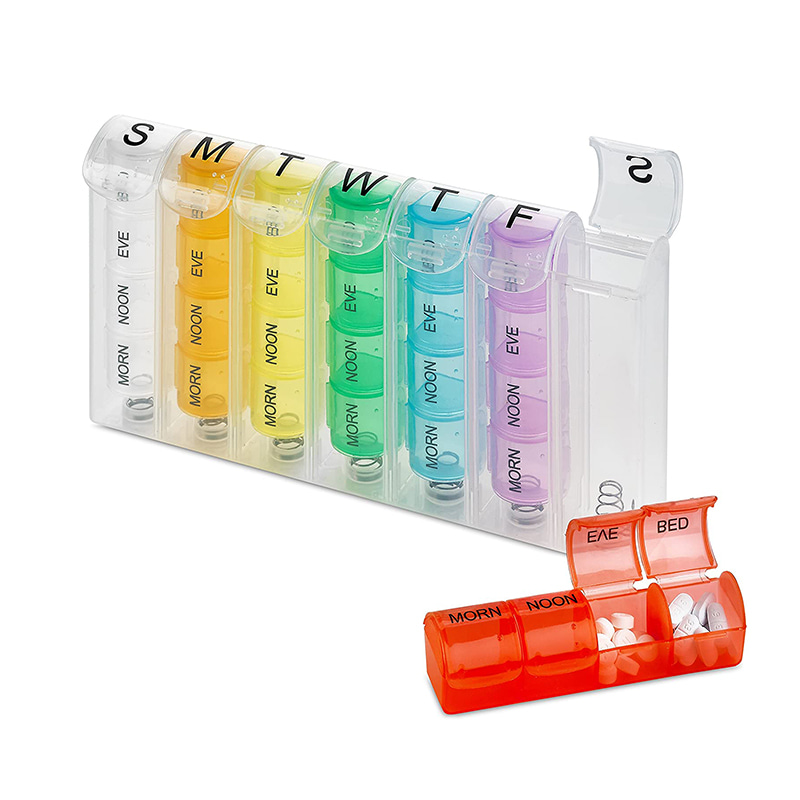
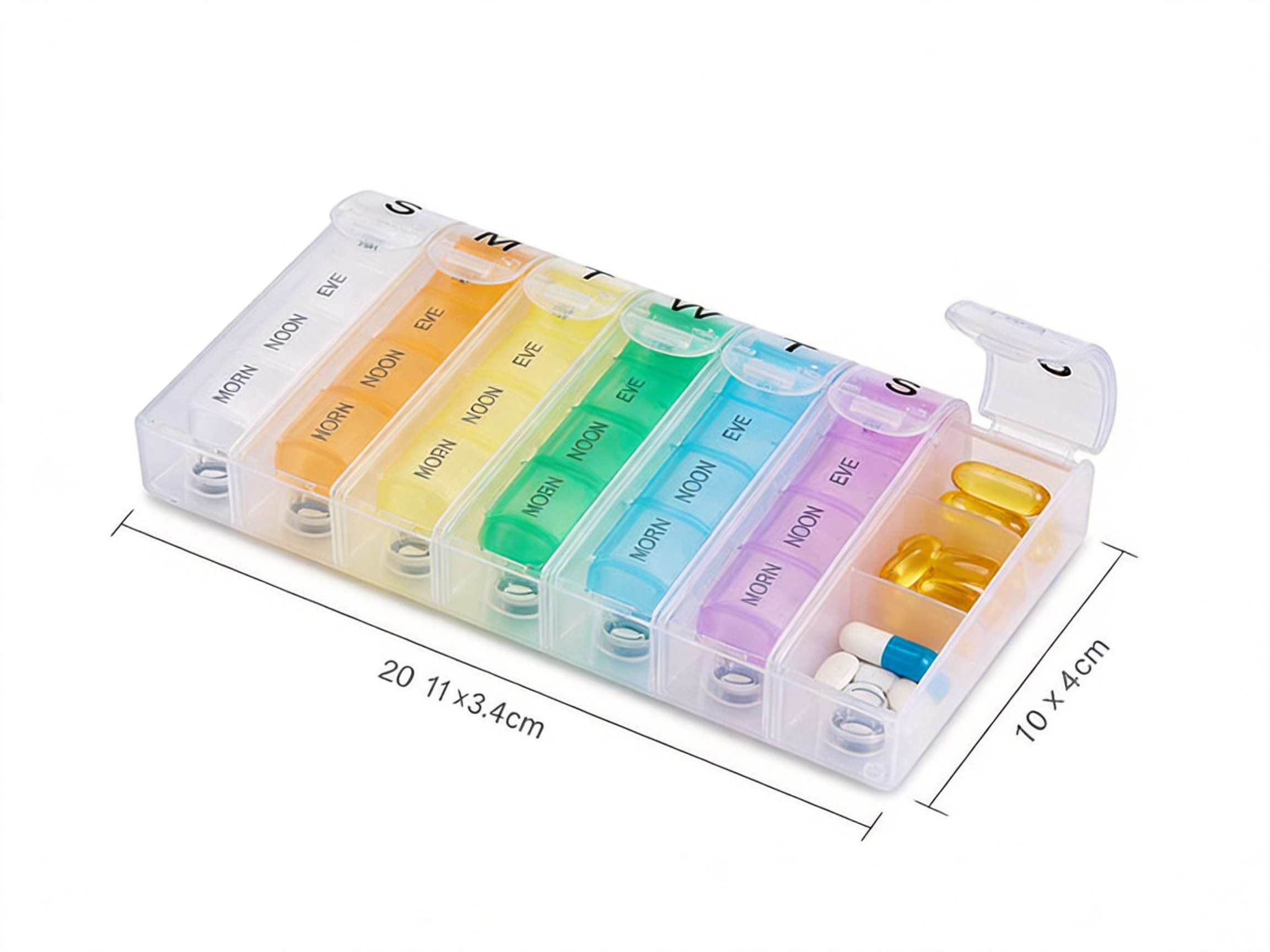
The product model is DC660180. It is a weekly pill organizer measuring approximately 20 x 11 x 3.4 centimeters and made from PP plastic. The unit contains seven individual day-marked organizers. Each daily organizer includes four compartments, providing a total of 28 time-based storage sections for a full week.
The daily units are arranged to support a familiar medication-planning pattern: morning, noon, evening, and bedtime. This format is easy to understand for users who take several supplements or medications at different times. It also helps family members, caregivers, and healthcare assistants review whether a particular day’s doses have been prepared.
| Product Attribute |
Specification or Feature |
| Product type |
Weekly pill organizer with pop-up daily units |
| Model |
DC660180 |
| Primary application |
Organization of fish oil, supplements, tablets, capsules, and suitable oral solid products |
| Daily planning format |
Seven individual day organizers |
| Compartments |
Four compartments per day: morning, noon, evening, and bedtime |
| Overall size |
20 x 11 x 3.4 cm |
| Material |
PP plastic |
| Lid design |
Translucent snap lids with day-of-week lettering |
| Minimum order quantity |
5,000 pieces |
| HS code |
3923100090 |
The compact size provides a useful balance between storage capacity and portability. It is large enough to provide 28 labeled sections, yet small enough to place in a suitcase, handbag, bedside drawer, or cabinet. The product’s lightweight construction makes it more convenient for regular travel than many rigid, oversized medication storage cases.
Why a Weekly Organizer Is Useful for Fish Oil and Supplements
Fish oil is commonly taken as part of a daily supplement routine. Depending on the instructions associated with a particular product, users may need to remember one or more capsules at a designated time. When fish oil is used alongside vitamins, minerals, or prescribed medicines, it can become difficult to remember which products have already been taken. A dedicated weekly organizer provides a visual planning system that can make a routine easier to follow.
The organizer does not replace dosage instructions, professional medical advice, or original product labeling. Instead, it provides a secondary method for arranging doses after the user has checked the applicable storage requirements and instructions. Some medicines and supplements may require original packaging, special temperature control, moisture protection, or light protection. Products with those requirements should not be transferred to a pill organizer unless the storage instructions permit it.
For suitable tablets and capsules, the seven-day structure reduces the need to open multiple bottles during the week. A user can prepare the compartments in advance and then check the relevant day and time. The translucent lids make it possible to see the contents without immediately opening every section, while the day letters help identify the intended date grouping.
This visual method can be especially valuable for people with busy schedules, frequent travel, multiple daily supplements, or shared household routines. A caregiver can also use the day markings to review whether a section has been opened. However, the organizer should be used only by people who can safely identify their medicines and manage their own dosing, or under appropriate supervision.
Exceptional Design Features
Seven Individual Day Organizers
The product includes seven separate daily pill organizers rather than one undivided weekly container. This arrangement gives each day a defined physical unit. Users can remove or handle one daily section without needing to carry the entire week’s supply.
Individual units can also make preparation more flexible. For example, a user may place the current day’s organizer in a handbag or carry case while leaving the remaining units at home. This can help reduce the amount of medication-related equipment carried during short trips. It also provides a convenient way to distinguish prepared days from unprepared days.
For retailers and distributors, the seven-unit format offers a clear product benefit that can be communicated easily on packaging and product listings. It is more informative than simply describing the item as a “weekly pill box,” because it explains how the week is separated and why the design is convenient.
Four Time-of-Day Compartments
Each daily organizer contains four compartments for morning, noon, evening, and bedtime. This four-period structure supports a broader range of routines than a simple once-daily or twice-daily box. Users can assign products to the time period indicated by their instructions and prepare the day in an orderly sequence.
The four-compartment configuration also reduces the need to estimate which dose belongs to which part of the day. Clear time divisions can be helpful when several products have different administration schedules. The compartments are intended for organization, not for changing a dosage schedule. The product’s role is to provide a physical reminder and storage arrangement for a schedule that has already been established.
Contoured Shape for Easy Pill Removal
The organizer has a contoured design intended to make pill removal easier. A shaped compartment can help users access tablets and capsules without having to shake the entire unit or insert fingers deeply into a narrow, flat cavity. This is a practical advantage for users who want a quicker and cleaner way to retrieve a dose.
The contoured design may also help reduce the chance of small tablets remaining in corners. The exact suitability of a compartment depends on the size and shape of the product being stored. Users should check that all tablets or capsules fit comfortably and that lids close fully before using the organizer as part of a regular routine.
Translucent Snap Lids
The lids are translucent, allowing users to view the contents of each section without opening the lid. This creates a simple visual check. A user may be able to see whether a compartment appears full or empty, while the snap-lid construction helps keep the daily sections closed during ordinary handling.
Translucent lids are particularly useful when combined with day-of-week lettering. The user can identify the day and inspect the compartment in one step. This can be more convenient than opening an opaque container or searching through several unlabeled compartments.
Pop-Up Opening Mechanism
Once a lid is opened, the daily pill organizer is designed to pop up. This feature gives the product a distinctive user experience and makes the selected day more noticeable. The pop-up action can help the daily section stand out from the remaining units, supporting a clear visual routine.
The pop-up design also adds functional differentiation in a crowded pill-organizer market. Many conventional boxes rely only on hinged lids or removable trays. A pop-up mechanism gives this model a more interactive and recognizable format while maintaining a compact overall size.
Advantages Compared with Basic Pill Boxes
Not all pill organizers provide the same level of organization. A basic pill box may include one or several undivided compartments, but it may not separate both the day and the time of day. The DC660180 format addresses this issue through seven daily units and four sections within each unit.
Its principal advantage is structured visibility. A user can identify the day, the planned time period, and the contents of the relevant section without opening the entire weekly supply. This arrangement is more systematic than placing all tablets for several days in one container.
A second advantage is portability. The organizer is lightweight and compact, making it suitable for travel and everyday carrying. Because the daily units are separated, users may choose to take only the current day’s section for a short outing. This can be more convenient than carrying a large weekly case.
A third advantage is user-friendly access. The contoured compartments and pop-up feature are designed to make removal and identification easier. The translucent lids provide a quick visual reference, and the snap closures help keep the units closed during ordinary transport.
A fourth advantage is merchandising flexibility. The bright and attractive colors can improve shelf visibility and make the organizer more appealing to consumers who prefer practical products with a more approachable appearance. Color can also support household organization, although the product should not be used as a substitute for written labeling when medicines are involved.
| Comparison Point |
Basic Single-Compartment Box |
DC660180 Weekly Organizer |
| Weekly separation |
Often limited or absent |
Seven individual day-marked organizers |
| Time-of-day planning |
May not be available |
Four compartments per day |
| Contents visibility |
Depends on container design |
Translucent lids support visual checking |
| Daily portability |
Usually requires carrying the whole box |
Individual daily units can be handled separately |
| Access design |
May use flat or narrow compartments |
Contoured design supports pill removal |
| User recognition |
May rely on plain labels |
Day letters and pop-up presentation improve recognition |
These differences do not mean that one organizer is suitable for every person or every medicine. The best choice depends on the user’s routine, the quantity and size of the products, storage requirements, and ability to manage the organizer safely. The value of this model is that it combines several practical features in one compact format.
Material Selection and Product Durability
The organizer is made from PP plastic, a material widely used in consumer healthcare and household storage products. PP is valued for its light weight, practical rigidity, and suitability for molded components. In this product, the material supports a portable structure that can be used repeatedly during daily planning and travel.
The product is described as rugged and durable, with a construction intended for long-term use. Durability in a pill organizer depends on several factors, including the quality of the molded parts, hinge or snap performance, lid alignment, resistance to repeated opening, and the way the product is transported and cleaned.
Users should keep the organizer clean and dry and follow appropriate care instructions. It should not be exposed to conditions that could deform the plastic or damage the lids. The organizer should also be inspected periodically. If a compartment, lid, or closure becomes damaged, the product should be replaced to prevent confusion or loss of contents.
From a manufacturing perspective, PP plastic allows consistent production through controlled molding processes. Proper control of material handling, mold temperature, cooling, trimming, and assembly can help maintain dimensional stability. Consistent dimensions are important because the seven units must fit together properly, the lids must align with the compartments, and the pop-up action must function as intended.
Manufacturing Strengths and Quality Management
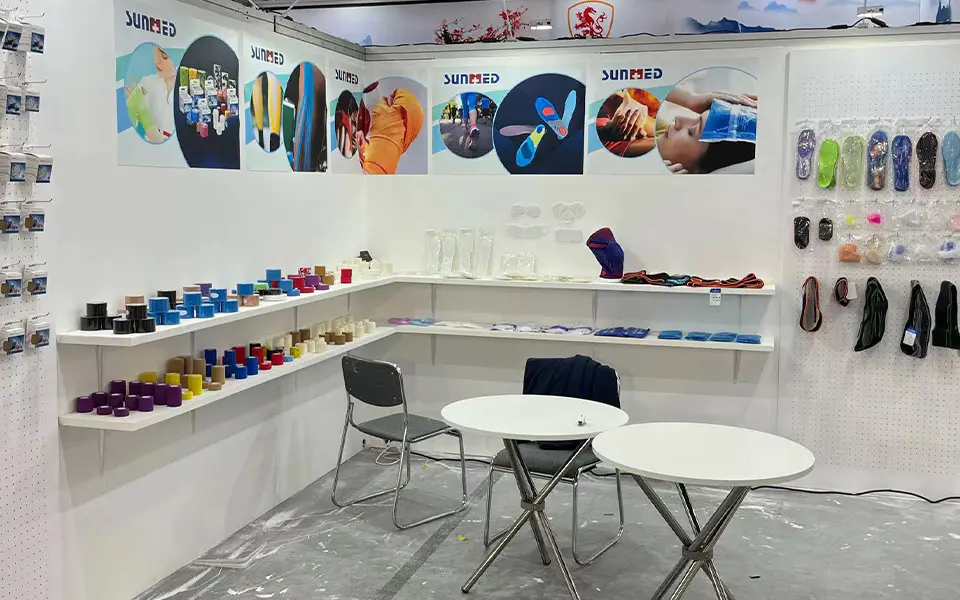
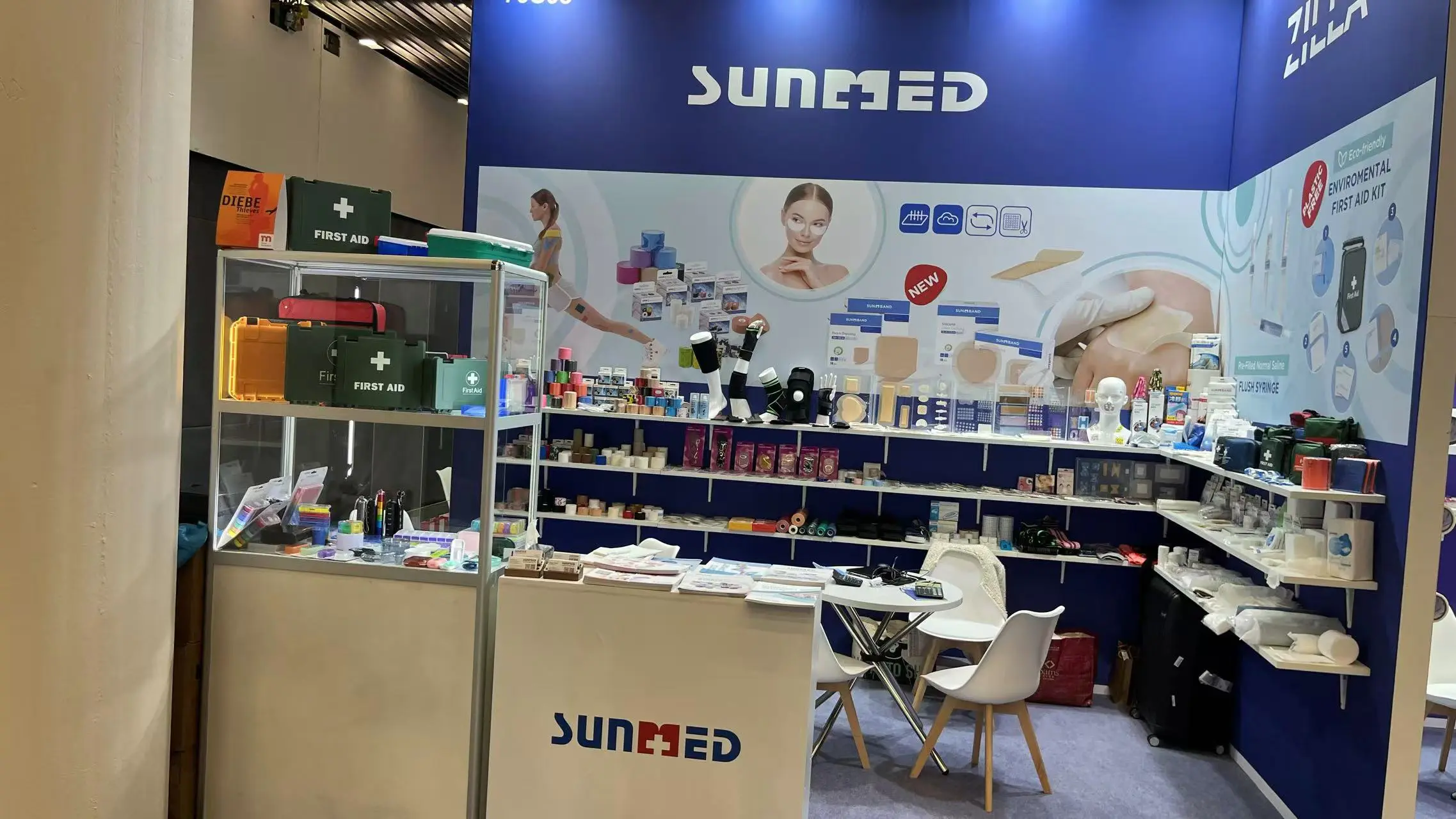
The manufacturer behind this product is an experienced Chinese producer and exporter of first-aid, medical, and healthcare products. Its manufacturing scope covers wound dressings, gauze, bandages, medical tape, medical cotton, non-woven products, sports support products, family healthcare items, pill boxes, hot and cold packs, medical instruments, syringes, catheters, surgical consumables, and other healthcare supplies.
This broad product portfolio is relevant to the production of a weekly pill organizer because it reflects experience across both consumer healthcare and professional medical supply categories. Different product categories require different material controls, inspection procedures, packaging methods, and customer documentation. Experience across these areas can support a disciplined approach to product development and order fulfillment.
The company operates multiple production bases in Jiangsu, Zhejiang, and Anhui Province. A multi-base manufacturing structure can support production capacity, sourcing coordination, and product specialization. It may also allow the manufacturer to manage a broader range of healthcare products while maintaining dedicated production arrangements for particular categories.
The company reports approximately 30 years of experience in the medical device and medical consumables industry. Long-term experience can be valuable for buyers seeking continuity, especially when purchasing products for hospitals, first-aid suppliers, supermarkets, pharmacies, retail sports stores, or healthcare distributors. It can also support communication regarding specifications, packaging, inspection requirements, and export documentation.
In 2008, the manufacturer established a first-aid factory to serve first-aid customers. In 2021, it established a factory for kinesiology tape, cohesive bandages, and elastic adhesive bandages in response to customer demand. These investments demonstrate an approach based on expanding dedicated production capabilities as product categories grow.
Inspection and Process Control
The manufacturer reports a professional quality control team comprising hundreds of personnel. According to the supplied company information, the team follows inspection procedures aligned with ISO 13485:2016 requirements. ISO 13485 is a quality management standard associated with medical devices and related regulatory expectations. Its application can support documented processes, traceability, corrective action, and controlled production activities where applicable.
For a pill organizer, quality control may include checks of raw materials, molded components, dimensions, color consistency, surface condition, lid fit, snap performance, compartment integrity, lettering, assembly, and packaging. Inspection requirements should be agreed with the buyer and matched to the product’s intended market and classification.
Quality inspection is especially important for products with several moving or interlocking parts. The seven daily units need to remain identifiable and functional. The four compartments within each unit must be properly formed. The translucent lids should be clear enough to support visual checking, and the snap closures should be tested for secure but practical operation.
Manufacturing control also includes the prevention of foreign material, sharp edges, molding defects, stains, incomplete lettering, and dimensional variation. Packaging inspections can help ensure that products arrive without cracking, deformation, or missing components. A consistent inspection system helps reduce variation between production batches and supports customer confidence in large-volume purchasing.
OEM and Wholesale Cooperation
The stated minimum order quantity is 5,000 pieces, making the product suitable for wholesale, distribution, private-label, pharmacy, supermarket, and institutional purchasing programs. Buyers may discuss packaging, labeling, color arrangements, carton configuration, product inserts, and market-specific documentation with the manufacturer.
For OEM or customized programs, buyers should define all requirements before production begins. Important details may include artwork, logo placement, language requirements, color standards, barcode information, packaging materials, carton marks, testing documentation, inspection standards, and delivery schedules.
Large-volume purchasing can also support coordinated product launches. A distributor may combine the pill organizer with other family healthcare products, such as hot and cold therapy items, sports support products, first-aid supplies, or selected wound-care products. This can help retailers create a broader home healthcare section rather than presenting the organizer as an isolated item.

Applications in Retail, Home Healthcare, and Distribution
Pharmacies and Healthcare Retailers
Pharmacies can position the organizer near supplements, fish oil products, vitamins, home healthcare goods, and medication-management accessories. Its four-times-daily structure offers a clear reason for purchase and can be explained easily by retail staff. The compact dimensions also make it suitable for countertop displays, shelf placement, or packaged healthcare ranges.
Supermarkets and General Retail
Supermarkets increasingly include practical healthcare products alongside personal care and wellness goods. The bright colors and compact design can help the product stand out in a general retail environment. Clear packaging should communicate that the item is a weekly organizer with seven daily sections and four time-of-day compartments.
First-Aid and Family Healthcare Suppliers
First-aid suppliers may add the organizer to a home healthcare portfolio. Although it is not a wound-care product, it complements first-aid kits and household medical supplies by addressing routine supplement and medication organization. It can also be included in family care bundles or wellness gift programs.
Hospitals, Clinics, and Care Settings
Healthcare institutions may use pill organizers in selected educational, discharge, or home-care support programs, subject to their own policies and applicable regulations. The product may help demonstrate the concept of weekly medication planning. However, professional staff should determine whether it is appropriate for a particular patient, medicine, or care plan.
Travel and Active Lifestyles
The lightweight format is useful for travel, work, study, and outdoor activities. A user can prepare the weekly schedule before leaving home and carry the entire organizer or selected daily units. The compact profile helps conserve space in luggage and personal bags.
Correct Preparation and Use
Before filling the organizer, users should review the instructions for each medicine or supplement. They should confirm the correct product, dosage, timing, storage conditions, and suitability for transfer from the original packaging. If a product requires special packaging or has a warning against repackaging, it should remain in its original container.
The organizer should be placed on a clean, dry, stable surface. Users can prepare one day at a time or fill all seven units according to a written schedule. Each product should be placed in the compartment corresponding to its established administration time. If multiple products are taken together, the user should ensure that the compartment is large enough and that the products can be safely stored together.
After filling, each snap lid should be closed securely. The user should check the day letters and confirm that the daily units are in the correct order. A written medication list, calendar, or preparation checklist can provide an additional safeguard, especially when several products are involved.
During use, the translucent lid can provide a quick visual check. The user should avoid relying solely on whether a compartment looks empty, because some tablets or capsules may be difficult to see. If there is uncertainty about whether a dose was taken, the user should follow an established medication-management procedure rather than taking an additional dose without confirmation.
Children and individuals who may accidentally ingest medication should not have unsupervised access to the organizer. The product is a planning aid, not a child-resistant medicine container. It should be stored safely according to the requirements of the household and the products being organized.
Cleaning, Handling, and Storage Considerations
A pill organizer should be kept clean and dry. Before cleaning, users should remove all contents and verify that no tablets or capsules remain in the compartments. Cleaning instructions should be compatible with PP plastic and the product’s lid structure. Excessive heat, harsh chemicals, abrasive tools, or prolonged soaking may affect the appearance or function of the organizer.
After cleaning, all parts should be completely dry before they are refilled. Moisture inside a compartment may affect certain tablets or capsules. Users should also avoid storing the organizer in direct sunlight, near radiators, or in locations with extreme heat or humidity unless the relevant product instructions permit those conditions.
The daily units should be handled carefully during travel. Although the product is designed to be durable and lightweight, it should not be compressed under heavy objects. Users should inspect the organizer after travel to ensure that the lids remain closed and that no compartment has cracked or opened.
Commercial Benefits for Buyers
For wholesale buyers, the product offers a combination of functional differentiation and broad consumer relevance. Fish oil, vitamins, and daily supplements are widely used, and many consumers need a better way to organize them. A product that supports four daily planning periods can serve users with more complex routines than a simple one-compartment box.
The model also has strong visual merchandising potential. Bright colors can create a friendly presentation, while the pop-up construction offers a feature that can be demonstrated in retail or online video content. The translucent lids provide an immediately understandable benefit, and the day-of-week markings make the product’s purpose clear at a glance.
The compact dimensions can help reduce storage and shipping volume compared with larger medication-management cases. Buyers can evaluate the packaging configuration, carton quantity, and pallet arrangement with the manufacturer to improve logistics efficiency. Actual freight performance will depend on final packaging and order requirements.
For private-label customers, the basic product structure can serve as a foundation for a broader branded line. Potential market segments include senior care, family wellness, travel accessories, sports nutrition, pharmacy retail, home nursing, and general personal care. Any customized claims, labeling, or market positioning should be reviewed for compliance with the destination country’s applicable requirements.
Product Positioning Against Competing Designs
The pill-organizer market includes flat weekly cards, large daily trays, compact travel boxes, electronic reminder systems, and simple single-compartment containers. The DC660180 occupies a practical middle position. It is more structured than a small travel box, more portable than a large multi-dose tray, and simpler to operate than an electronic reminder device.
Its strongest point of differentiation is the combination of physical separation and visual access. Seven individual daily units divide the week, while four compartments divide each day. Translucent lids allow the user to inspect the sections, and the pop-up feature provides a tactile and visual indication of the selected unit.
Electronic dispensers may offer alarms or digital tracking, but they typically require batteries, programming, and a higher level of user interaction. The DC660180 does not depend on power or software. This makes it suitable for users who prefer a straightforward, low-maintenance organizer.
Some large weekly trays may provide more capacity, but they can be less convenient to carry. This product focuses on a compact format that supports ordinary supplement and medication planning without excessive bulk. Its suitability depends on the size and number of products being stored, so buyers should confirm compartment capacity during evaluation.
Supply Reliability and Export Experience
The manufacturer has exported healthcare products to more than 60 countries, including markets in Europe, Southeast Asia, Africa, and Oceania. Reported destination markets include the United Kingdom, Germany, Spain, Denmark, the Netherlands, Japan, Malaysia, the Philippines, Thailand, Tanzania, Mauritius, South Africa, Australia, and New Zealand.
International export experience can help buyers coordinate shipping documentation, packaging expectations, product specifications, and communication across different markets. It does not automatically guarantee compliance in every destination. Importers remain responsible for verifying local regulations, product classification, labeling, customs requirements, and any required testing or registration.
The company’s reported customer base includes hospitals, first-aid suppliers, supermarkets, and retail sports shops. This variety indicates experience with different purchasing models, from institutional orders to consumer retail distribution. A buyer can use this background as a starting point for discussions about forecast planning, quality documentation, production scheduling, and after-sales communication.
Recommended Buyer Evaluation Checklist
Before placing a large order, buyers should request product samples and evaluate the overall design. The inspection should include the fit of every lid, the operation of the pop-up mechanism, the clarity of the day markings, the consistency of the colors, the smoothness of the edges, and the ability of the compartments to hold the intended tablets or capsules.
Buyers should also confirm the final product dimensions, material specification, packaging configuration, available colors, minimum order quantity, lead time, and shipping terms. If the product will be sold in a regulated healthcare channel, buyers should request relevant quality and compliance documents for review.
Packaging should be checked for protection during transport and for clear consumer information. Important information may include the product name, model, material, instructions for use, cleaning guidance, warnings, storage advice, importer details, barcode, batch information, and disposal instructions, depending on the destination market.
| Evaluation Area |
Questions for the Buyer to Confirm |
| Function |
Do all seven daily units open, close, and pop up correctly? |
| Capacity |
Are the compartments suitable for the intended tablet and capsule sizes? |
| Materials |
Does the PP plastic specification meet the buyer’s requirements? |
| Markings |
Are the day letters clear, durable, and appropriate for the target market? |
| Packaging |
Does the packaging protect the organizer and provide required information? |
| Quality |
What inspection standard, sampling plan, and documentation will apply? |
| Commercial terms |
Are the MOQ, lead time, colors, carton details, and shipping terms acceptable? |
| Compliance |
Has the product been reviewed against destination-market requirements? |
Frequently Asked Questions
What is the product designed to organize?
The organizer is designed for suitable tablets, capsules, fish oil products, vitamins, supplements, and routine oral solid medicines. Users must check the storage requirements and instructions for each product before transferring it from its original packaging.
How many daily sections does it contain?
It contains seven individual day-marked organizers, representing the seven days of a week.
How many compartments are available each day?
Each daily organizer has four compartments intended for morning, noon, evening, and bedtime planning. Across the full week, this provides 28 compartments.
Are the lids transparent?
The lids are translucent. This allows users to see the contents of a compartment without opening it completely, although visual inspection should not replace a proper medication checklist or dosing record.
What does the pop-up feature do?
When a lid is opened, the daily pill organizer is designed to pop up. This makes the selected day more noticeable and adds convenience to the opening process.
Is the product suitable for travel?
Its lightweight construction and compact size make it travel-friendly. Users may carry the complete organizer or a selected daily unit, provided the products inside can safely be stored in that manner.
Is it child-resistant?
The product is a pill organizer and should not be treated as a child-resistant medicine container. It must be kept safely away from children and anyone who could accidentally ingest the contents.
Can all medicines be placed in the organizer?
No. Some medicines and supplements require original packaging, moisture protection, light protection, refrigeration, or other special conditions. Users should follow the product label and professional guidance before repackaging anything.
What material is used?
The organizer is made from PP plastic. This material supports a lightweight molded construction suitable for a reusable daily planning product.
What is the product size?
The stated overall size is approximately 20 x 11 x 3.4 centimeters.
What is the minimum order quantity?
The stated minimum order quantity is 5,000 pieces. Buyers should confirm current commercial terms and packaging details directly during the quotation process.
Can the product be customized?
Potential customization options should be discussed with the manufacturer. Buyers may inquire about packaging, colors, labeling, inserts, carton marks, and private-label requirements. Any custom specification should be approved before mass production.
What quality system supports production?
The manufacturer reports quality control procedures aligned with ISO 13485:2016 requirements and a large professional quality control team. Buyers should request the specific certificates, inspection records, and compliance documentation applicable to their order and destination market.
Who may benefit from this product?
It may benefit adults who need to organize suitable supplements or medicines, travelers, caregivers, pharmacies, healthcare retailers, supermarkets, first-aid suppliers, and distributors. Individual suitability depends on the user’s health situation, medication routine, and ability to manage doses safely.
Conclusion
The DC660180 Pop Up Weekly Pill Organizer for Fish Oil combines a seven-day structure with four time-of-day compartments, creating a practical 28-section system for routine supplement and medication planning. Its contoured compartments support pill removal, its translucent snap lids provide visual access, and its pop-up daily units offer a distinctive and convenient user experience.
Compared with simpler pill boxes, the organizer provides clearer separation by day and time, better portability, and a more recognizable design. Its PP plastic construction supports lightweight everyday use, while the compact 20 x 11 x 3.4 centimeter format is suitable for storage and travel.
For wholesale and OEM buyers, the product is supported by a manufacturer with extensive experience in first aid, medical consumables, family healthcare, sports support, and medical device categories. Multiple production bases, international export experience, reported ISO 13485:2016-aligned quality procedures, and a substantial quality control team provide a foundation for organized large-volume supply.
As with every pill organizer, safe use requires attention to product-specific storage instructions, correct dosing information, child safety, and professional guidance where necessary. When used appropriately, this weekly organizer can provide a simple, visible, and convenient way to structure a seven-day routine for fish oil, supplements, and suitable oral solid products.
References
1. Product specification sheet for model DC660180, including dimensions, material, compartment structure, and minimum order quantity.
2. Manufacturer-provided company profile covering medical consumables, family healthcare products, production bases, export markets, and quality management practices.
3. ISO 13485:2016, Medical Devices—Quality Management Systems—Requirements for Regulatory Purposes.
4. General principles of safe medication organization, storage, labeling, and administration as advised by healthcare professionals and product manufacturers.
5. General guidance for handling dietary supplements and medicines according to original packaging instructions and destination-market requirements.

 English
 Español
 русский
 Français
 Deutsch
 italiano
 By Admin