Preparedness depends on having essential medical supplies available, protected, and easy to carry. The Custom Waterproof EVA Red Empty First Aid Case with Zipper Closure is designed to provide a practical storage solution for first aid materials, personal healthcare items, and emergency accessories. Its compact hard-shell construction, recognizable red color, protective interior, and customizable production options make it suitable for households, workplaces, vehicles, travel, outdoor activities, retail programs, and institutional distribution.
Unlike a basic fabric pouch, this empty first aid case is built around a durable EVA shell that helps shield its contents from pressure, light moisture, dust, and everyday handling. Unlike a fully equipped first aid kit, it gives purchasers the flexibility to select the medical contents that match their local regulations, customer requirements, treatment protocols, or intended application. This combination of protection and customization makes the case a versatile platform for private-label first aid kits and professional supply programs.
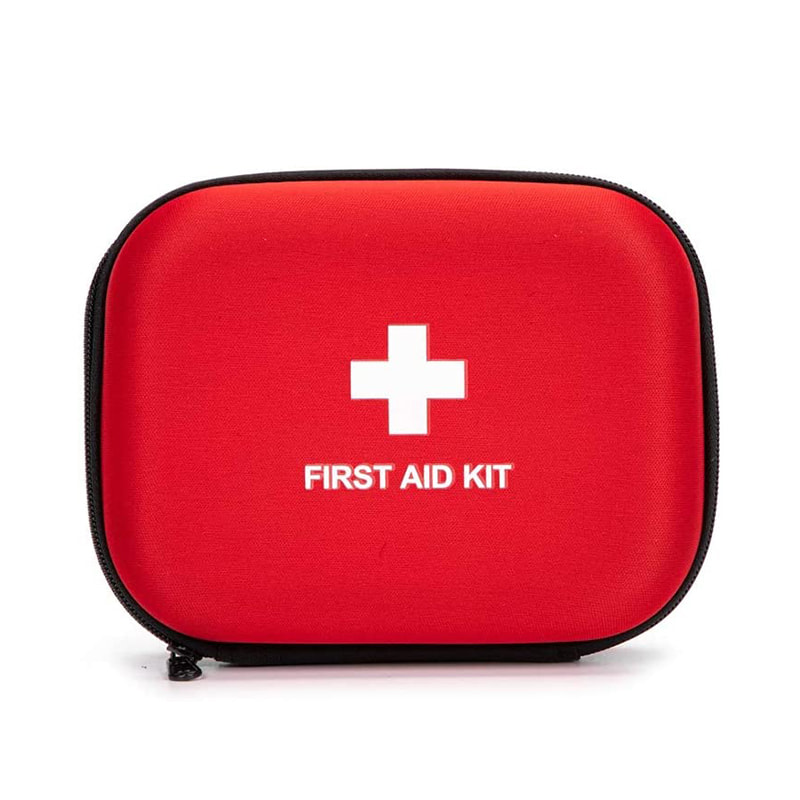
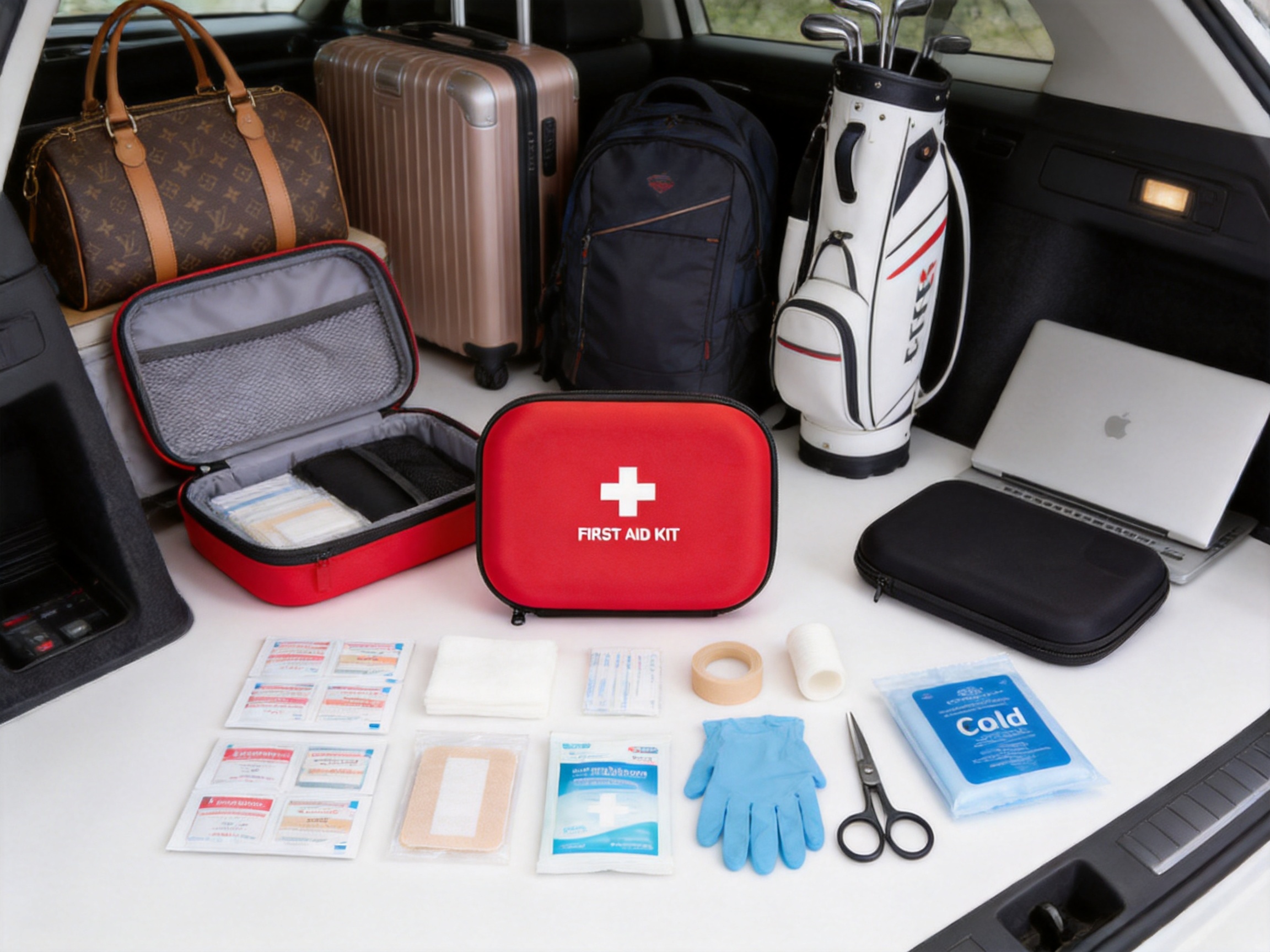
The case measures approximately 17.2 x 13.5 x 5.6 centimeters, or about 6.8 x 5.3 x 2.2 inches. This size is compact enough to fit inside a handbag, luggage compartment, golf bag, laptop case, vehicle storage compartment, or office drawer while still providing useful space for commonly required first aid articles. It is supplied empty, allowing distributors, pharmacies, supermarkets, insurance companies, employers, schools, and healthcare organizations to assemble contents according to their own needs.
With a minimum order quantity of 2,000 pieces and color options including red, green, blue, and customizable alternatives, the product is especially suitable for wholesale and OEM programs. The red version offers immediate visual recognition in an emergency, while custom colors can support a corporate identity, retail range, public safety program, or specialized medical supply campaign.
Product Overview and Intended Use
A first aid case must perform more than a simple storage function. It should be easy to recognize, comfortable to transport, sufficiently durable for repeated handling, and adaptable to different contents. The Custom Waterproof EVA Red Empty First Aid Case with Zipper Closure addresses these requirements through a combination of form, material, closure design, and production flexibility.
The case is categorized as an empty first aid bag, but its hard-shell EVA construction gives it a more protective profile than many soft-sided alternatives. The shell helps maintain the shape of the case when it is stored in a crowded bag or vehicle compartment. It also reduces the likelihood that packaged bandages, gauze, tape, wipes, gloves, or other supplies will be crushed during transportation.
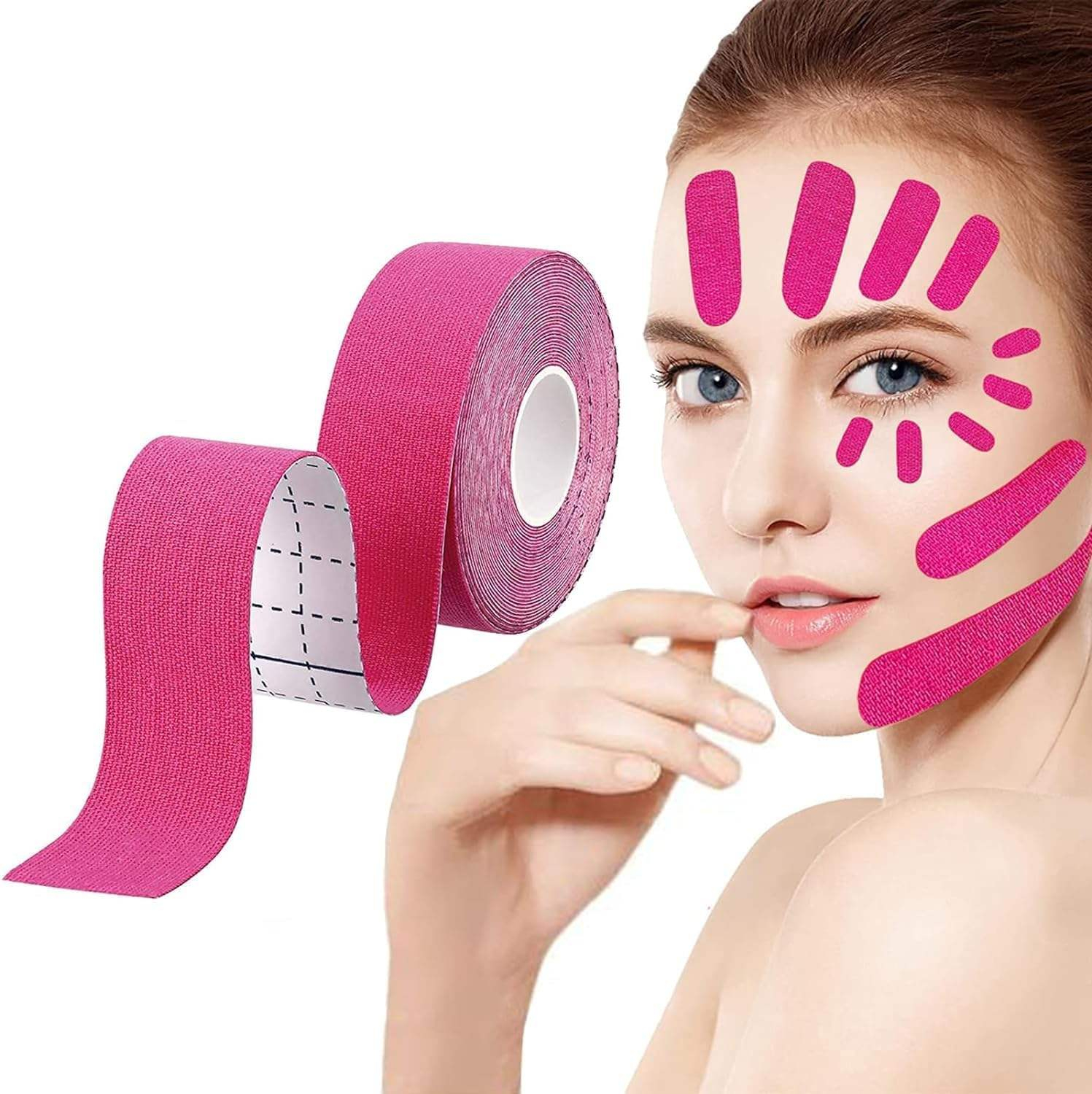
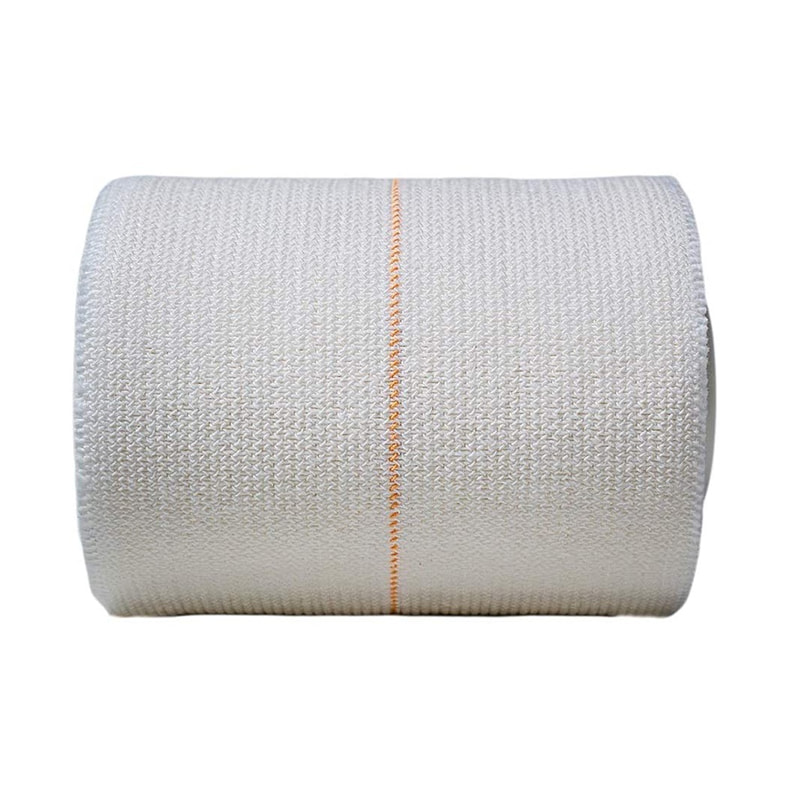
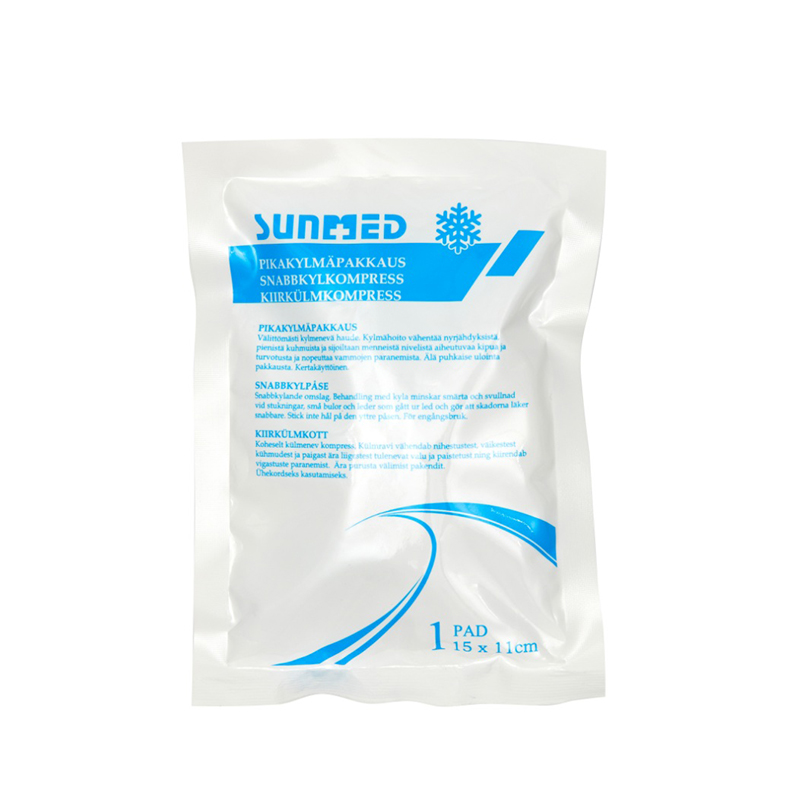
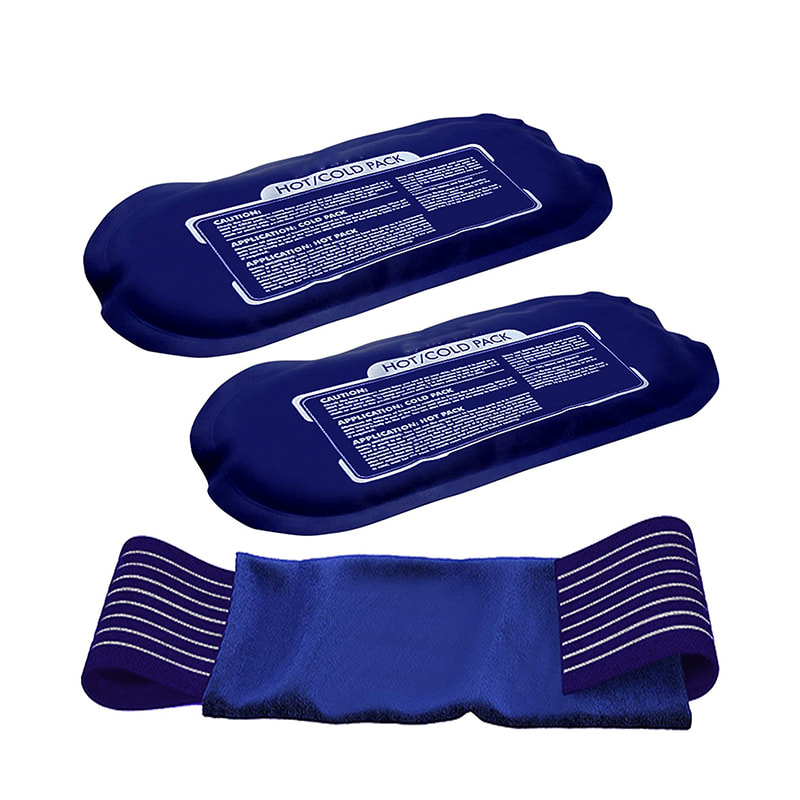
Because the case is empty, buyers can decide what goes inside. A family-oriented configuration may contain adhesive bandages, antiseptic wipes, gauze pads, medical tape, cotton products, disposable gloves, scissors, and a cold pack. A workplace configuration may include protective gloves, wound dressings, burn treatment products, eye protection, and emergency instructions. An outdoor configuration may focus on blister protection, sports tape, elastic support, cleansing wipes, and compact wound-care items.
The same case can therefore serve multiple market segments without requiring the manufacturer to create a completely different outer product. This is a commercial advantage for wholesalers and distributors because one case design can support several product bundles, price levels, and sales channels.
Compact Size for Everyday Portability
The dimensions of 17.2 x 13.5 x 5.6 centimeters are selected to balance portability with practical storage capacity. A case that is too large can be difficult to carry and may be left behind during travel. A case that is too small may not hold the supplies required for routine emergencies. This model occupies a compact footprint while offering sufficient depth for organized first aid contents.
Its portable format is appropriate for handbags, backpacks, suitcases, golf bags, laptop cases, vehicle compartments, and desk drawers. It can also be placed in a reception area, warehouse office, classroom, retail counter, hotel cabinet, or sports facility. The compact shape allows organizations to distribute individual cases to employees, travelers, students, athletes, or customers without creating a significant storage burden.
Portability is particularly important in first aid because the case may need to move to the location of an incident rather than remain in one fixed cabinet. A lightweight, compact case can be carried quickly to a minor injury, outdoor activity, sports event, or roadside situation. Its hard shell also helps the case retain its structure while being moved.
The dimensions are suitable for products that are individually packaged and relatively flat or compact. Before final assembly, purchasers should review the size and quantity of the intended contents. Different items have different packaging dimensions, and the internal capacity should be confirmed when creating a customized kit. This planning process helps avoid overfilling and supports smooth zipper operation.
Custom Waterproof EVA Red Empty First Aid Case with Zipper Closure
EVA Hard-Shell Construction
EVA, or ethylene-vinyl acetate, is widely used in protective cases because it combines low weight with useful flexibility and impact resistance. In this first aid case, the EVA shell provides a structured exterior that is more protective than an unreinforced textile pouch. The material is suitable for routine carrying, storage, and distribution in consumer and professional environments.
The hard-shell format helps protect the contents from compression caused by other items in a bag. For example, a case stored under clothing in a suitcase or beneath equipment in a vehicle may experience pressure during normal transportation. A structured shell reduces direct crushing forces and helps prevent the case from collapsing around its contents.
EVA also contributes to the product’s lightweight character. A metal case or heavily rigid plastic container may offer strength but can add weight and create hard edges. The EVA construction provides a practical alternative for customers who require a protective case that remains comfortable to carry. This is particularly useful for travel, sports, family use, and personal emergency kits.
The shell is also easy to handle and suitable for routine cleaning according to the user’s established procedures. While the case should not be treated as sterile medical packaging, its smooth exterior can be more convenient to wipe than porous fabric. Buyers should select cleaning agents and methods that are compatible with EVA and should avoid exposing the case to conditions beyond its intended use.
Water-Resistant Protection for Daily Storage
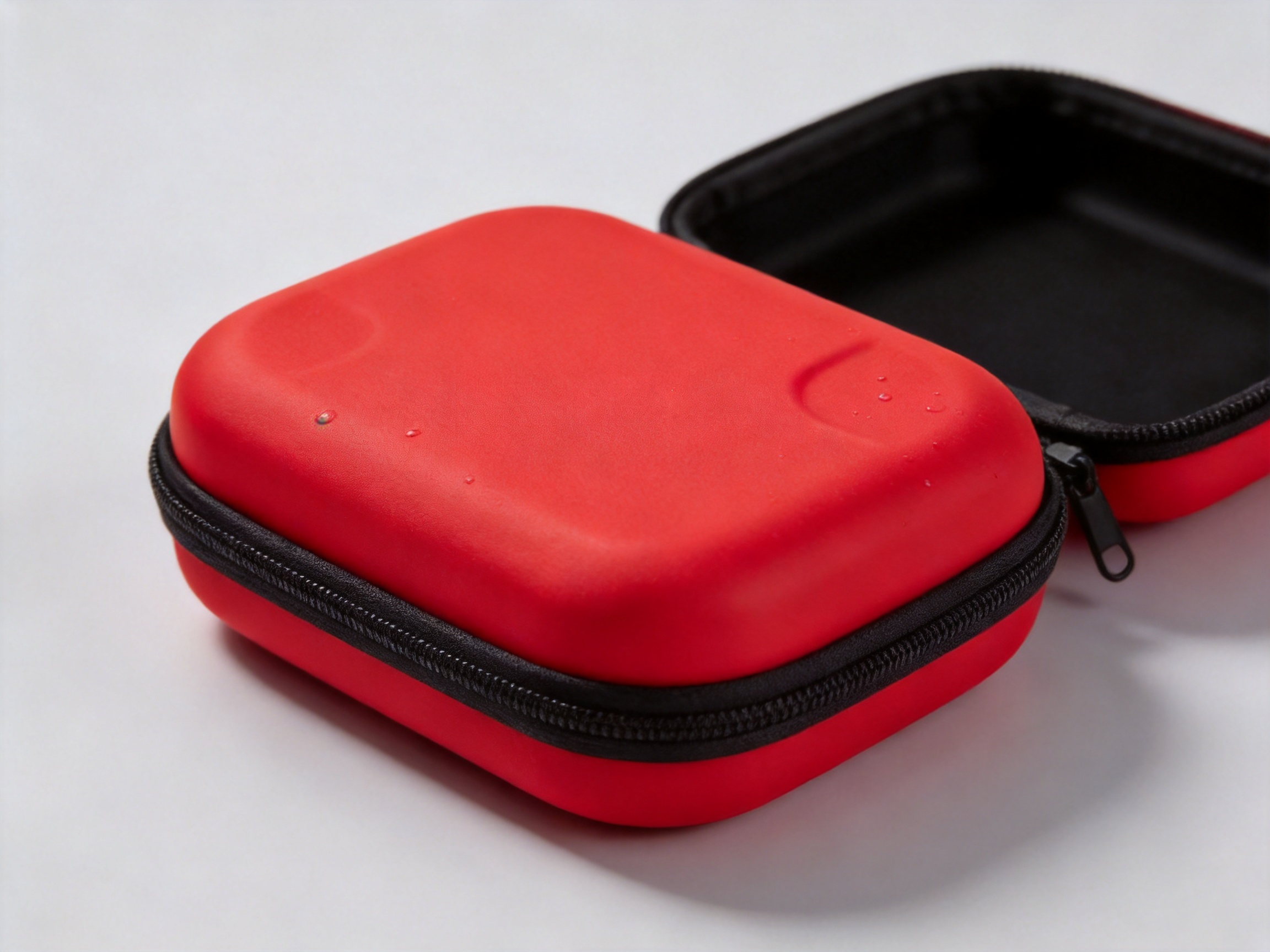
The waterproof or water-resistant design is an important advantage for first aid storage. First aid cases may be exposed to condensation, splashes, damp sports equipment, wet vehicle compartments, or changing outdoor conditions. A protective EVA shell and zipper closure help limit the entry of moisture during ordinary handling and storage.
The case should be understood as a protective storage product rather than a guaranteed solution for prolonged submersion. The level of protection depends on the condition of the zipper, the condition of the shell, the way the case is closed, and the environment in which it is used. Users should keep the zipper fully closed and should not intentionally immerse the case unless a specific tested waterproof rating has been established for the final configuration.
Moisture protection is valuable because many first aid supplies are packaged in paper, cardboard, or thin film. Gauze, adhesive bandages, medical tape, wipes, and instruction leaflets can be affected by damp conditions. A protective outer case helps create a more controlled storage environment and can reduce the risk of damage caused by ordinary splashes or humidity.
For outdoor, travel, and vehicle applications, water resistance can distinguish this product from inexpensive fabric bags. A fabric pouch may be lighter, but it may absorb moisture, lose its shape, and offer less protection from compression. The EVA case provides a more durable presentation and can help preserve the appearance of the kit during distribution and repeated use.
Zipper Closure and User Convenience
The zipper closure allows the user to open the case widely, place contents inside, and close the storage compartment securely. A zipper is familiar to consumers and can be operated quickly without complicated fasteners. It also supports repeated access when users need to replace used supplies or check inventory.
For institutional and commercial programs, a zipper closure is useful because the case can be opened during inspection and resealed after restocking. Employers, schools, sports clubs, hotels, and vehicle operators can establish regular review procedures for checking expiration dates, replenishing consumed items, and confirming that the case remains ready for use.
The closure also supports product customization. Different contents can be assembled into the same outer case, and the case can be reopened if a buyer needs to modify the kit for a particular market. This is more flexible than a permanently sealed package and can reduce the need to discard the entire outer container when the contents change.
Users should avoid forcing the zipper around an overfilled case. Correct organization and appropriate loading help reduce stress on the closure and protect the case from deformation. The compact dimensions make it useful for essential supplies, but it is not intended to replace a large emergency cabinet or a comprehensive trauma response pack.
Recognizable Red Color and Custom Color Options
Red is strongly associated with first aid and emergency assistance in many markets. A red case can be identified quickly in a crowded storage area, vehicle, office, home, or sports bag. This visual recognition may save time when a minor injury occurs and someone needs to locate supplies without opening multiple containers.
The product is available in red, green, and blue, with customizable color options. This range allows buyers to match the case to their sales strategy or usage environment. Red may be selected for general first aid. Green may support a healthcare or outdoor product line. Blue may be used for workplace safety, corporate distribution, or coordinated equipment systems.
Custom colors can also help organizations establish internal identification systems. For example, a company may use one color for general first aid, another for sports care, and a third for travel or personal healthcare. Color coding can complement labels, printed instructions, or inventory procedures.
Color customization is especially valuable in OEM and private-label projects. A distributor can create a consistent appearance across cases, bandages, tape, gauze products, and other healthcare accessories. A coordinated product family can improve shelf presentation and make it easier for customers to recognize related items.
Empty Case Design for Flexible Kit Assembly
The empty-case format is one of the product’s most important commercial features. Many first aid products are sold as preassembled kits, but a fixed assortment may not suit every country, customer group, or application. Regulations, preferred brands, product sizes, and treatment practices vary widely. An empty case allows the purchaser to control the final kit configuration.
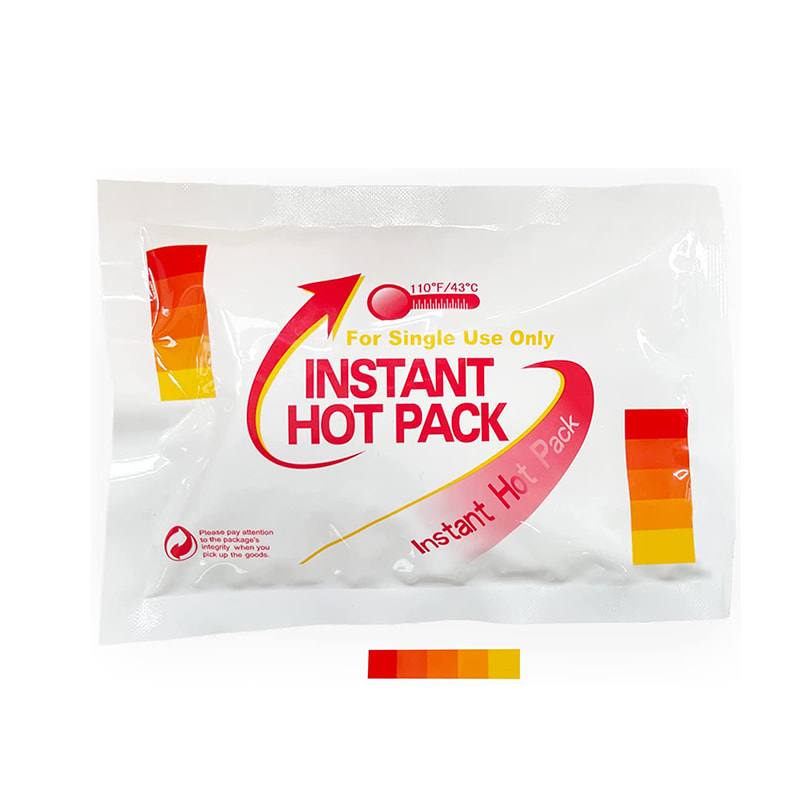
Wholesale buyers can use the case for multiple assembly programs. A basic retail version may contain adhesive bandages, cleansing wipes, and gauze. A family version may add medical tape, cotton products, scissors, disposable gloves, and hot or cold therapy items. A workplace version may be assembled according to an occupational safety plan. A sports version may include athletic tape, cohesive wrap, support products, and blister care.
This flexibility can simplify inventory management. Instead of purchasing numerous fully assembled cases from different suppliers, a distributor may purchase one standardized outer case and add contents through its own packing operation or an agreed manufacturing program. The same case can be offered through pharmacies, supermarkets, online stores, insurance promotions, corporate wellness programs, and first aid suppliers.
The empty format can also help customers meet local labeling and language requirements. Instruction cards, warning notices, product names, and usage information can be selected for the destination market. Buyers remain responsible for ensuring that the final contents, labeling, claims, and instructions comply with applicable regulations.
Because the product is not supplied with medical contents, purchasers should not assume that it provides treatment by itself. The case is a storage container. It must be filled with suitable products before it can function as a complete first aid kit.
Advantages Over Conventional Fabric First Aid Bags
Conventional fabric first aid bags are often economical and lightweight, but they may provide limited protection against compression, abrasion, and moisture. Their flexible walls can collapse when stored under other objects, making it more difficult to locate or organize contents. Fabric may also absorb liquid and can be more difficult to wipe clean after exposure to dirt or spills.
The EVA hard-shell case offers a more structured alternative. Its shape supports easier packing, stronger visual presentation, and improved protection during transport. The surface can be more convenient to maintain than porous textile material, and the shell can help prevent small packages from being crushed by everyday handling.
The zipper closure creates a defined storage compartment, while the compact dimensions help the case fit into personal bags and travel equipment. The result is a product that combines the portability of a soft pouch with some of the protective benefits associated with rigid containers.
Compared with low-cost unstructured pouches, the EVA case may also provide a more professional appearance for corporate gifts, insurance programs, pharmacy distribution, and branded retail products. Its hard-shell profile communicates that the product is designed for protection and repeated use rather than temporary packaging alone.
Advantages Over Large Rigid Medical Boxes
Large rigid first aid boxes can hold a broad assortment of supplies, but they are not always convenient for personal or mobile use. They may occupy considerable space, add weight, and be difficult to carry outside a fixed workplace or vehicle location. Their size may also discourage users from taking them on trips, hikes, sports outings, or business travel.
The compact EVA case is designed for situations where mobility is more important than maximum capacity. It is suitable for a focused selection of essential supplies and can be distributed to individuals or small teams. A company can provide one case to each vehicle, department, employee group, or field worker without requiring large storage cabinets.
It is not intended to replace a comprehensive medical station or a professional emergency response container. Instead, it fills the space between a loose collection of supplies and a large fixed first aid box. This focused role makes it practical for minor injuries, routine wound care, and personal preparedness.
Advantages Over Preassembled One-Size-Fits-All Kits
Preassembled kits are convenient, but they can contain products that are not needed by a particular customer or may omit items required for a specialized application. A buyer may also prefer different brands, packaging formats, quantities, or compliance documentation. The empty case gives purchasers control over the final assortment.
For wholesalers, this can improve product differentiation. Instead of selling an identical standard kit, a distributor can create versions for families, travelers, cyclists, golfers, offices, schools, factories, or outdoor enthusiasts. The exterior remains consistent while the contents and supporting materials change according to market demand.
Custom assembly can also support different price points. A compact basic kit can be offered as an entry-level product, while a premium version can include additional wound-care materials, protective equipment, and hot or cold therapy products. This makes the same case suitable for several retail and institutional channels.
Applications Across Multiple Markets
Household and Family Preparedness
Families often need a small first aid case for everyday cuts, abrasions, minor burns, splinters, and similar incidents. The compact format can be stored in a kitchen cabinet, bathroom drawer, vehicle, or travel bag. Parents can select contents suitable for children and adults, while households can add personal items according to their needs.
The red color makes the case easy to identify, and the hard shell helps protect contents from being squeezed among household items. The case can be checked periodically and restocked after use.
Travel and Tourism
Travelers may encounter minor injuries far from a pharmacy or medical facility. A compact empty case can be assembled with travel-appropriate supplies such as adhesive bandages, cleansing wipes, gauze, tape, gloves, and personal care items. Its size allows it to fit in luggage, a handbag, or a backpack without taking excessive space.
The protective shell is useful when luggage is handled repeatedly. It can help protect the contents from being compressed between clothing and other personal belongings. The water-resistant exterior also provides additional protection from ordinary travel splashes and damp conditions.
Sports and Outdoor Activities
Sports teams, gyms, golf clubs, camps, hiking groups, and outdoor organizations can use the case as a compact platform for activity-specific first aid supplies. Athletic tape, cohesive bandages, cold packs, blister products, gauze, and wound dressings can be selected according to the activity.
The case can be stored in a golf bag, sports equipment bag, team kit, or event organizer’s backpack. Custom colors may help sports clubs coordinate the case with uniforms or equipment, while the red option offers immediate first aid recognition.
Workplaces and Industrial Environments
Small offices, workshops, warehouses, retail locations, and service vehicles may require several compact first aid cases rather than one centralized box. The case can be assigned to departments, work vehicles, or mobile teams. Its contents can be selected to support the hazards and procedures of the particular workplace.
Organizations can use scheduled inspections to confirm that the zipper closes correctly, the shell is intact, and the contents are complete and within their designated shelf life. The case itself is not a substitute for a workplace risk assessment or legally required first aid equipment, but it can support a broader preparedness program.
Pharmacies, Supermarkets, and Retail Programs
The product is suitable for retail packaging and promotional programs because the outer case is compact, recognizable, and customizable. Pharmacies and supermarkets can sell it empty as a reusable storage case or fill it with selected medical and personal care products.
Insurance companies, employers, schools, and healthcare organizations may also use the case as a promotional or educational gift. Its practical function gives it continuing value after distribution, which can improve customer engagement compared with disposable promotional products.
Suitable Content Categories
The empty case can be paired with a broad range of small first aid and healthcare products. Common examples include adhesive bandages, sterile or non-sterile gauze pads, medical tape, cotton products, antiseptic wipes, disposable gloves, burn dressings, scissors, tweezers, instant cold packs, and emergency instruction cards.
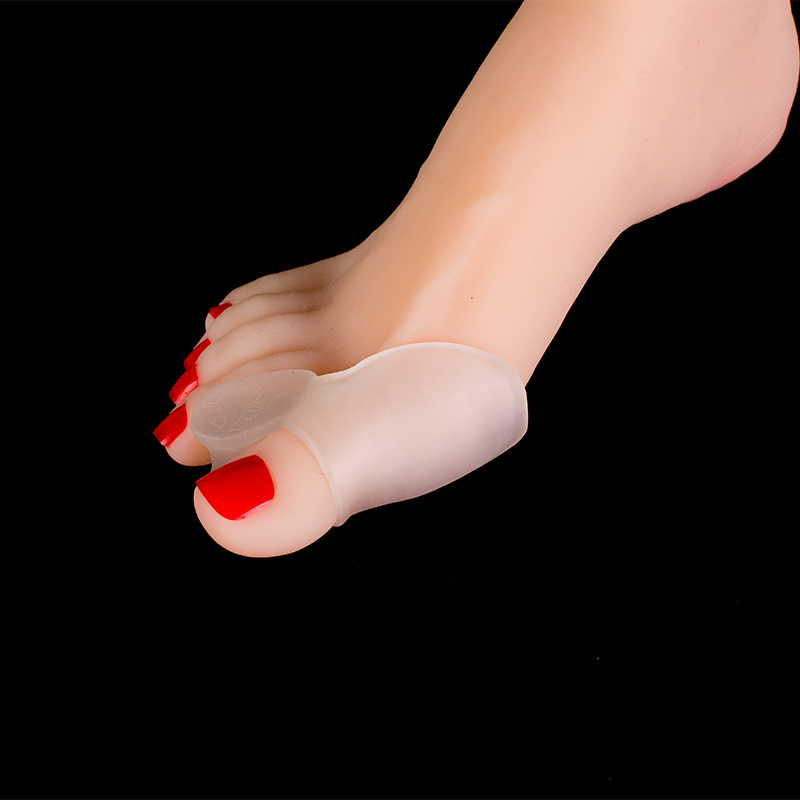
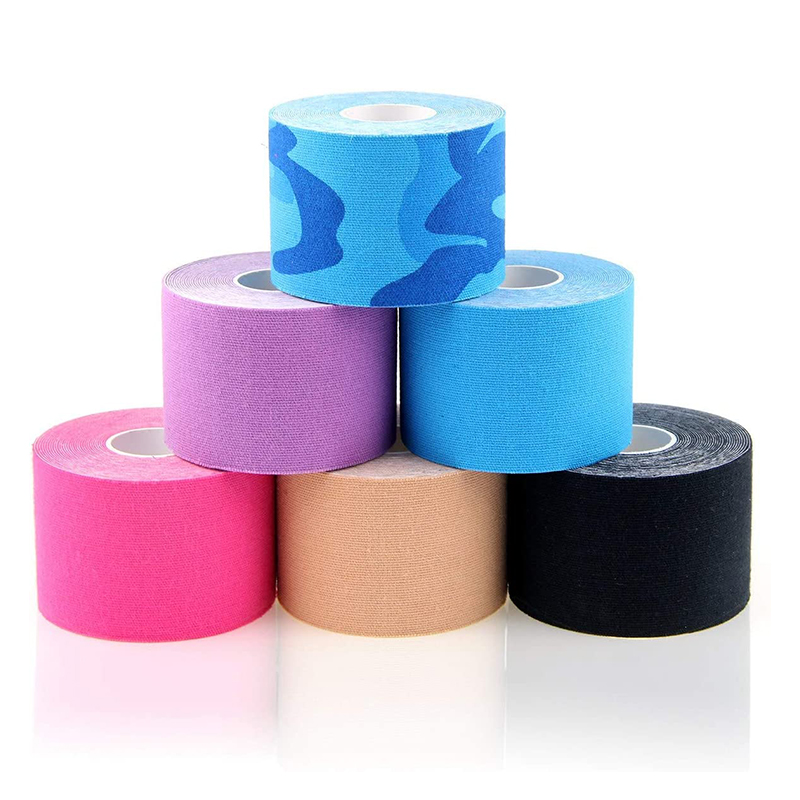
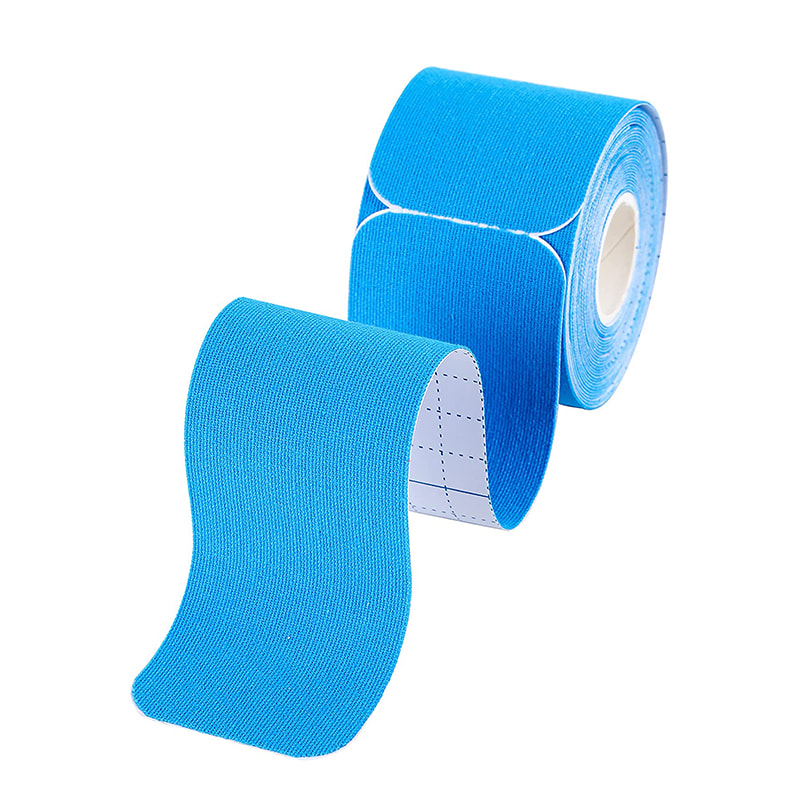
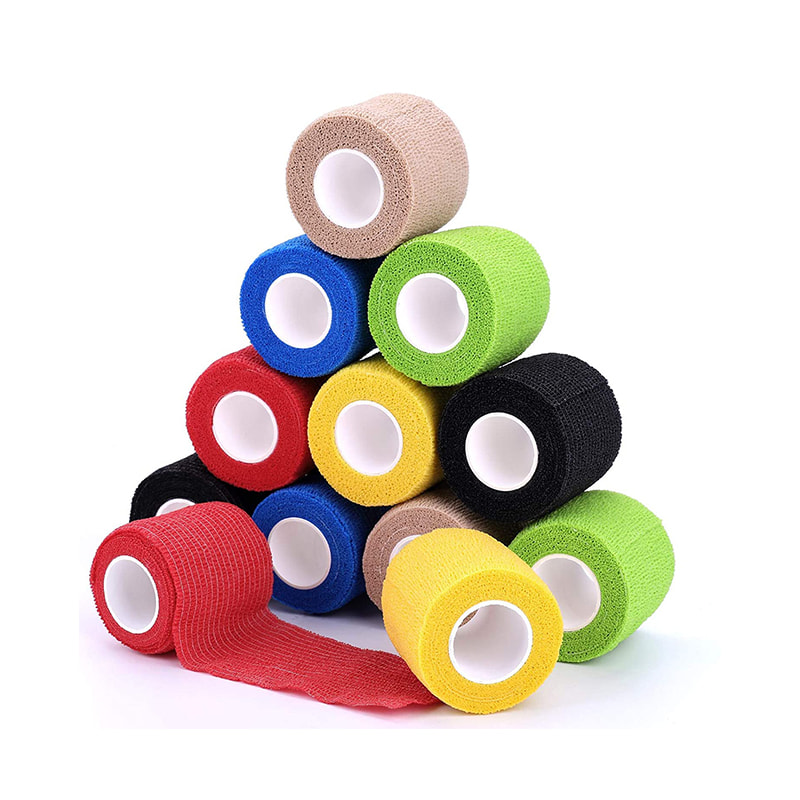
For athletic use, the case may contain sports support products such as athletic tape, cohesive bandages, elastic adhesive bandages, kinesiology tape, blister protection, and compact hot or cold therapy products. The selected contents should be compatible with the available internal space and should not prevent the zipper from closing smoothly.
For family and daily care applications, purchasers may include basic wound-care supplies, personal hygiene products, protective gloves, and individually packaged care items. For specialized uses, buyers should consult qualified healthcare or safety professionals when selecting the contents and instructions.
The case should not be used to store loose sharp instruments, leaking liquids, unprotected powders, or products that may damage EVA. Any sharp items should be separately protected. Liquids should be securely sealed and packed to prevent leakage. Contents should remain in their original packaging whenever possible, particularly when product identification, expiration information, and usage instructions are important.
Manufacturing and OEM Capabilities
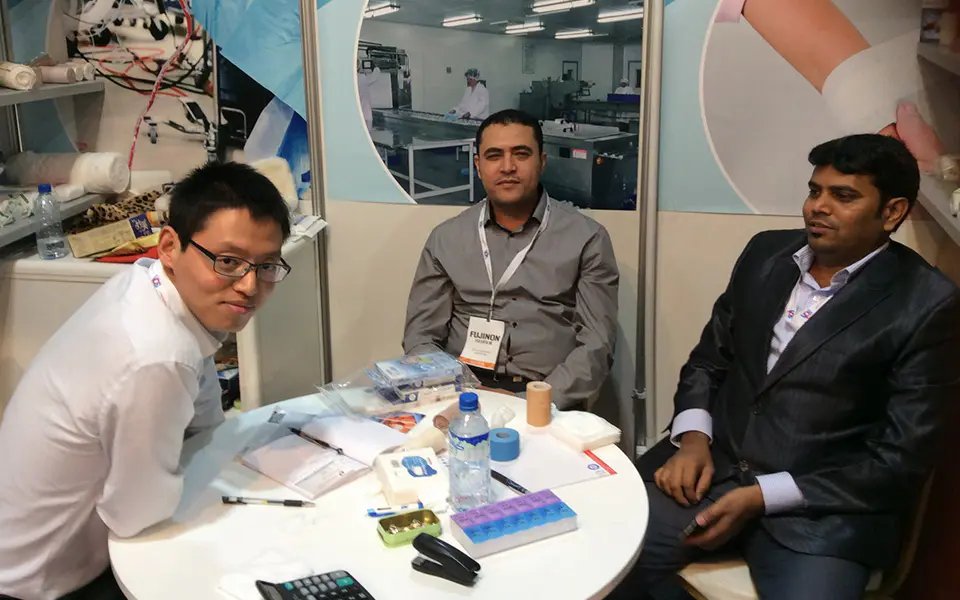
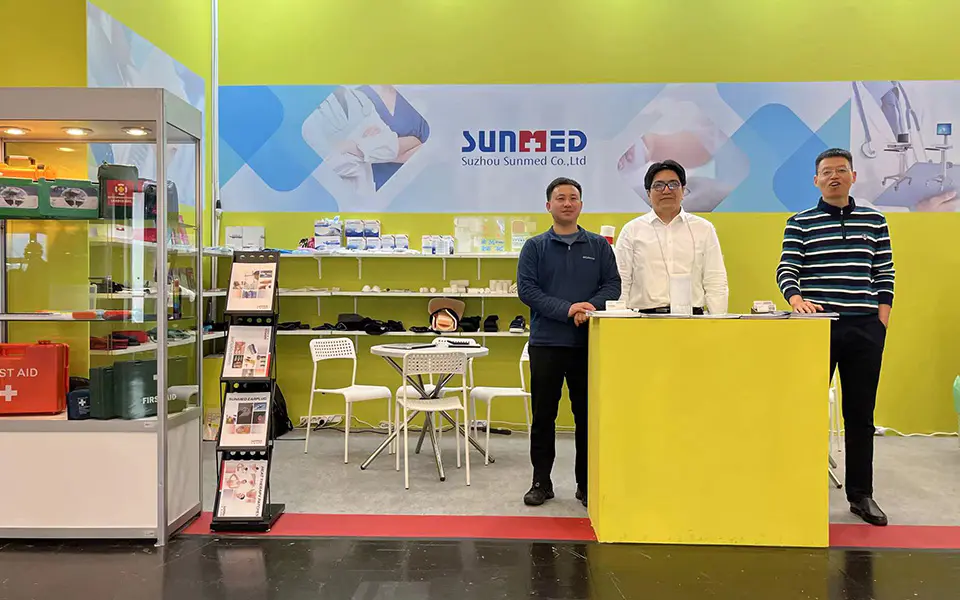
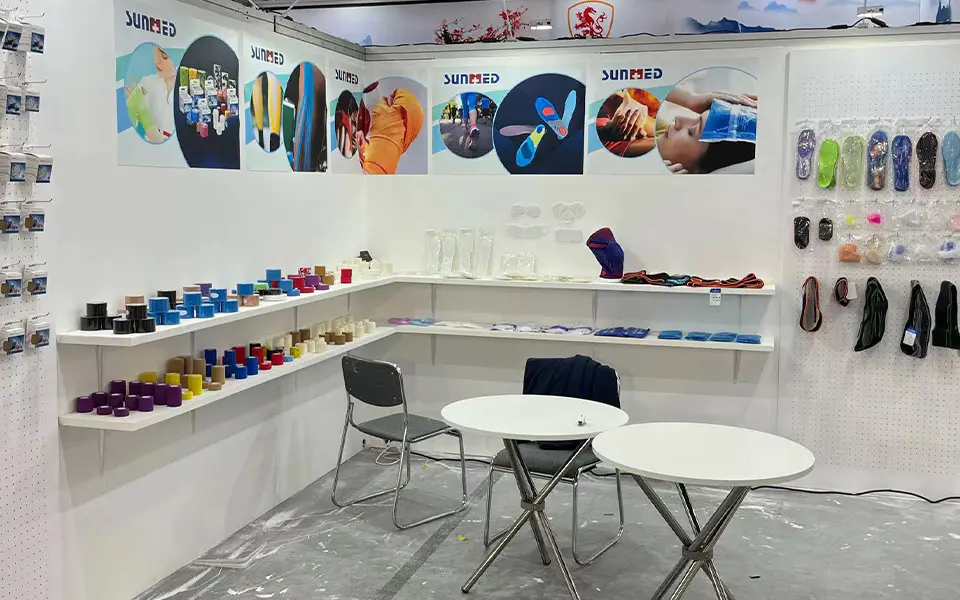
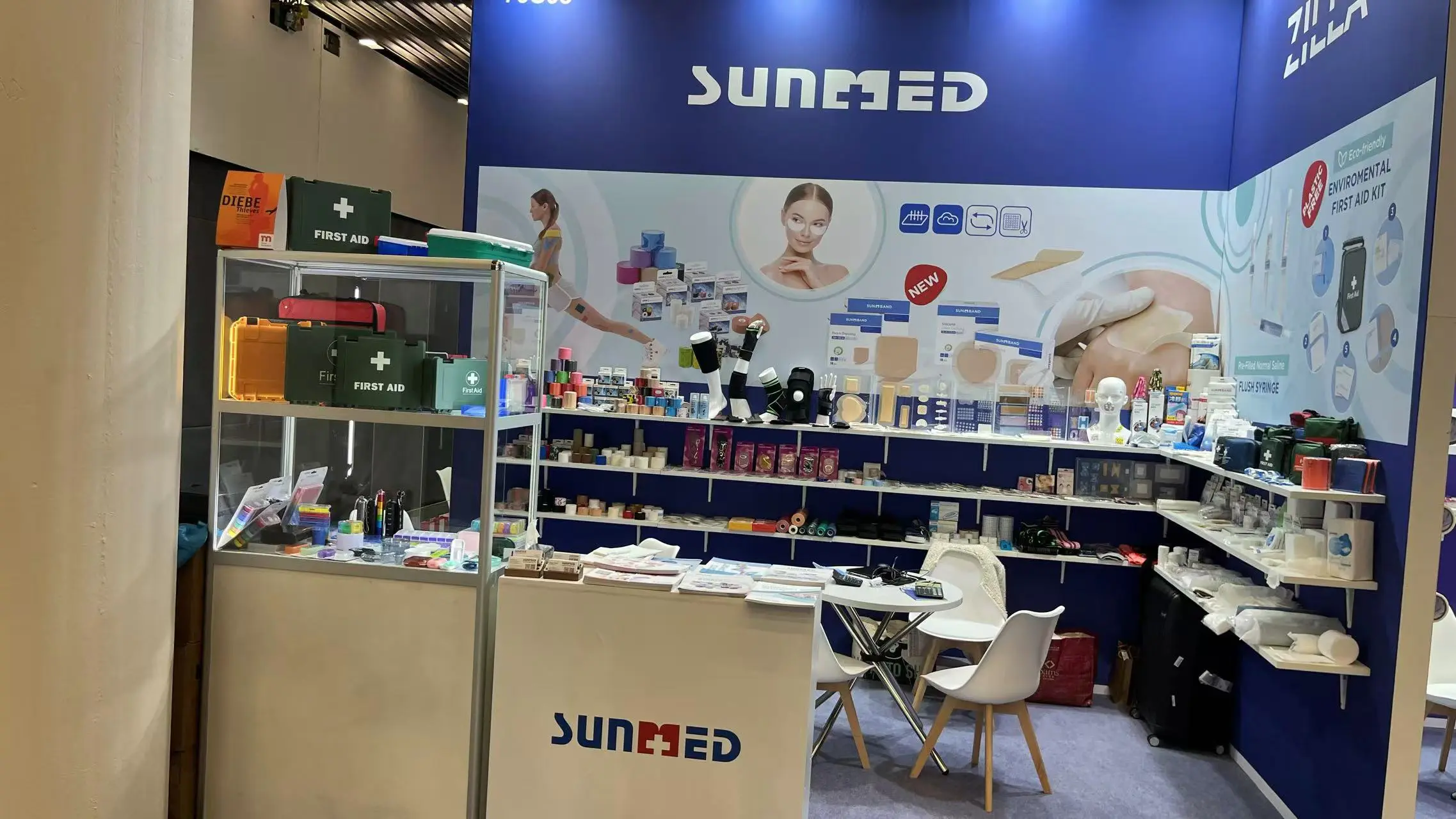
Suzhou Sunmed Co., Ltd. is a professional manufacturer and exporter of first aid, medical, and healthcare products in China. Its product portfolio includes first aid supplies, wound dressings, medical gauze, bandages, medical tape, medical cotton, non-woven products, sports bandages, family healthcare products, pill boxes, hot and cold packs, disposable syringes, catheters, surgical consumables, and other medical supplies.
The company operates multiple production bases in Jiangsu, Zhejiang, and Anhui Province. This manufacturing network supports a broad product range and allows the organization to coordinate different categories within one supply relationship. For buyers developing a complete first aid program, this can simplify sourcing across outer cases, wound-care materials, sports support products, and related healthcare items.
The company established its first aid factory in 2008 to respond to the needs of first aid customers. In 2021, it established an additional factory focused on kinesiology tape, cohesive bandages, and elastic adhesive bandages. These investments demonstrate a continuing effort to build dedicated production capabilities for both first aid and sports healthcare categories.
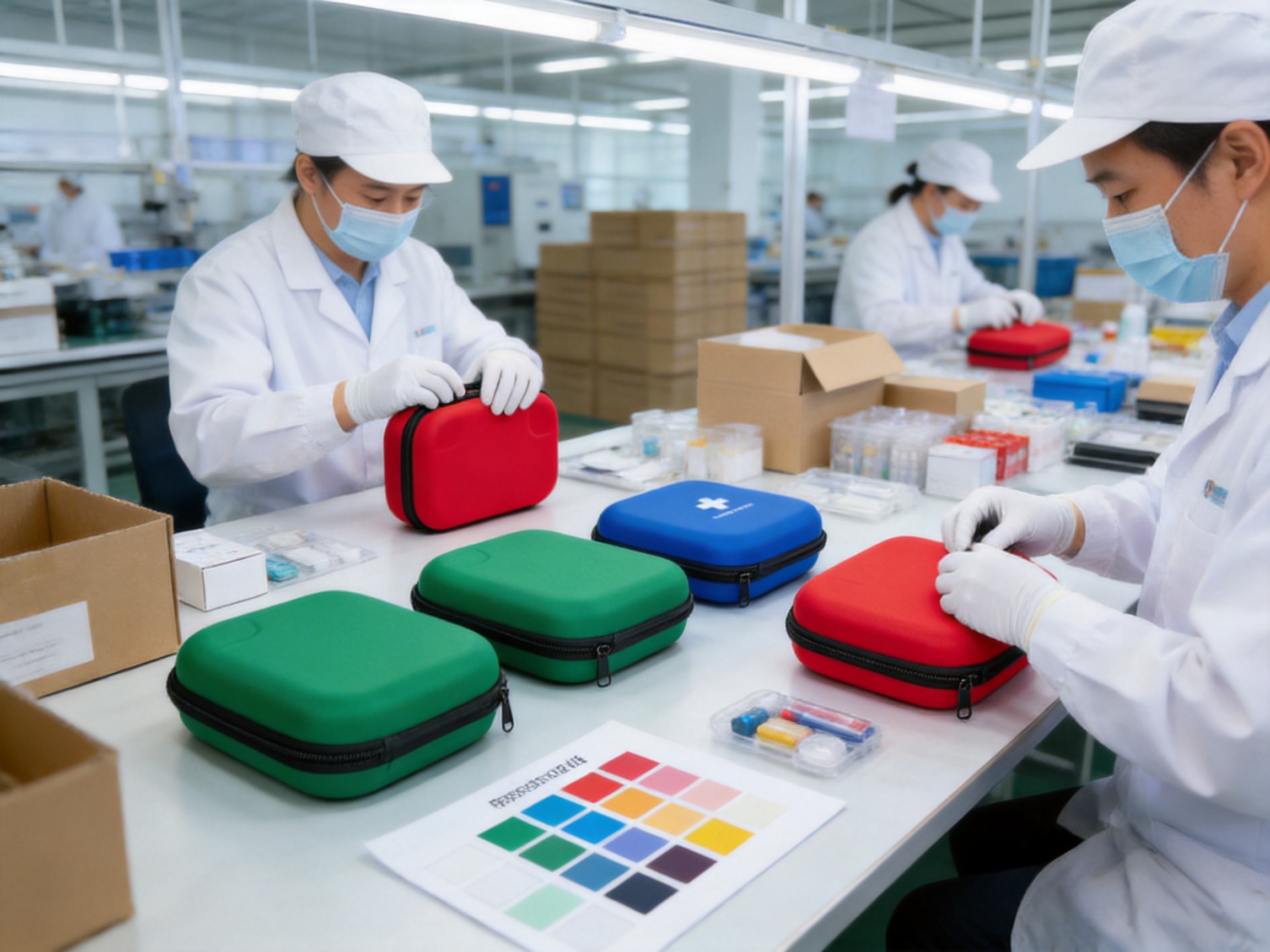
For the empty EVA case, manufacturing work includes material preparation, shell forming, trimming, component matching, zipper installation, sewing or assembly operations where applicable, visual inspection, dimensional checking, cleaning, packing, and shipment preparation. Each stage contributes to the consistency and usability of the finished product.
Material preparation is important because shell consistency influences appearance, flexibility, and protective performance. Production teams must ensure that the selected EVA material meets the agreed specifications for color, thickness, surface finish, and general condition. Custom colors require controlled matching against approved samples or agreed color references.
Forming and trimming processes determine whether the case maintains a uniform shape. Uneven edges, excessive flash, deformation, or surface defects can affect both appearance and closure performance. Careful trimming helps create a cleaner finished product and supports reliable assembly.
Zipper installation requires attention to alignment, stitching or bonding quality, end security, and opening performance. A zipper that is misaligned or exposed to excessive tension may affect the user experience. Inspection teams can check opening and closing operation, seam appearance, and the overall relationship between the zipper and the shell.
Final assembly and packing are also important for wholesale orders. Cases must be protected from dirt, compression, and unnecessary scratches during storage and transport. Carton packing should be planned according to the customer’s requirements, order quantity, shipping method, and destination market.
Quality Management and Inspection Strengths
The company states that it has a professional quality control team comprising hundreds of personnel. Its inspection procedures are designed to support products that meet ISO 13485:2016 standards, while most products are CE certified and its Suzhou factories comply with FDA requirements. Buyers should request product-specific certificates, declarations, reports, and quality documentation when evaluating a particular order.
For this case, quality control can include inspection of dimensions, color consistency, shell appearance, zipper function, stitching or assembly points, print or marking quality, packaging integrity, and quantity accuracy. These checks help reduce the risk of receiving products that are difficult to close, visibly damaged, incorrectly colored, or inconsistent across a shipment.
Quality control should begin with incoming materials and continue through production rather than relying only on final inspection. Early checks can identify material or component problems before they affect a large batch. In-process checks can identify forming, trimming, sewing, or zipper issues while corrective action is still efficient.
Final inspection provides an additional confirmation that the finished order meets agreed specifications. For custom projects, the approved sample, technical drawing, color reference, packing instruction, and labeling requirements should be used as the basis for inspection. Buyers may also arrange pre-shipment inspection through their own team or an independent inspection organization.
ISO 13485:2016 is associated with quality management systems for medical devices. The relevance of specific requirements depends on the product classification, intended use, market, and final configuration. An empty storage case may be treated differently from a complete medical device or sterile product. Purchasers should confirm regulatory responsibilities for their target markets before making product claims.
Export Experience and International Supply
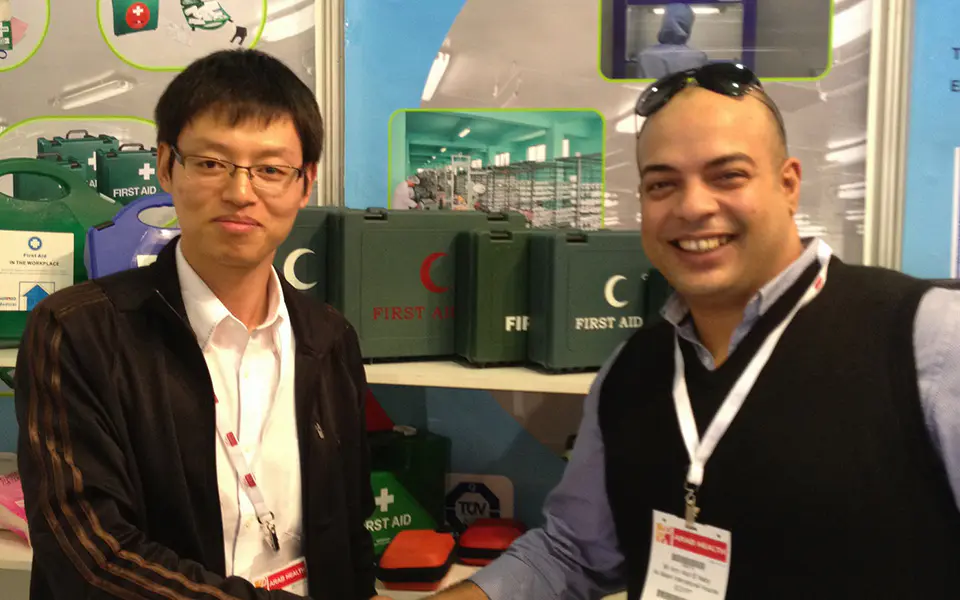
The company reports approximately 30 years of experience in the medical device and medical consumables industry and exports products to more than 60 countries. Its stated markets include Europe, Southeast Asia, Africa, and Oceania. This international experience can be valuable when buyers require export documentation, coordinated packaging, multilingual communication, and shipment planning.
International buyers often need more than a product sample. They may require commercial invoices, packing lists, certificates of origin, product specifications, inspection records, carton information, and other documents. An experienced exporter is better positioned to discuss these requirements during order development, although the exact documentation depends on the destination country and shipping arrangement.
The product’s HS code is listed as 4202920000. Buyers should independently confirm the correct customs classification with their customs broker or relevant authorities because classification can depend on construction, contents, destination, and local tariff interpretation.
The minimum order quantity is 2,000 pieces. This quantity is appropriate for wholesalers, distributors, private-label brands, promotional programs, and institutional buyers planning a coordinated launch. Custom colors, packaging, printing, and contents should be discussed during quotation because they may affect tooling, lead time, sample approval, and order quantity.
Customization Options for Private-Label Programs
Customization can be developed at several levels. The most basic option is color selection, with red, green, blue, and other agreed colors available subject to production feasibility. Color can be used to distinguish different product programs or create a consistent brand appearance.
Buyers may also discuss exterior printing, first aid symbols, labels, packaging sleeves, instruction cards, carton markings, and retail presentation. Any marking must be reviewed for legibility, durability, regulatory suitability, and language accuracy. The artwork should be approved before mass production begins.
Packaging customization may include individual polybags, paper boxes, display cartons, master cartons, barcode labels, batch information, and shipping marks. The best configuration depends on whether the product is sold online, placed on a retail shelf, distributed as a corporate gift, or assembled into a complete first aid kit.
Content customization is another major advantage. Buyers can purchase the case empty, fill it independently, or request a complete kit assembly program with selected medical products. If contents are included, the buyer and manufacturer should establish a detailed bill of materials, product specifications, quantities, language requirements, expiration controls, and regulatory documentation.
Sampling is recommended for every customized project. A sample allows the buyer to evaluate the shell, color, zipper, internal capacity, printing, packaging, and overall appearance. It also provides a reference for bulk production and helps identify design changes before the order is finalized.
Recommended Procurement Process
A successful wholesale order begins with a clear product brief. The buyer should state the intended market, target application, quantity, color, packaging method, printing requirements, desired delivery schedule, and whether the case will be supplied empty or assembled with medical contents.
The next step is technical confirmation. The buyer should verify the nominal dimensions of 17.2 x 13.5 x 5.6 centimeters, the available color range, the zipper design, the shell material, the case markings, and the expected tolerance. If the case will contain specific products, a packing trial should be completed before final approval.
Sample approval should cover both appearance and function. The buyer should open and close the zipper, inspect the shell for deformation, test the case in the intended bag or storage location, and confirm that the planned contents fit without excessive pressure. If the case is intended for damp or outdoor environments, the buyer should clarify the expected level of water resistance and any available test information.
After sample approval, the order should specify the agreed color, artwork, packing method, carton quantity, inspection requirements, and documentation. A written specification helps prevent misunderstandings between the buyer and production team.
Before shipment, the buyer may request production photographs, a quality inspection report, carton dimensions, gross and net weights, and final quantity confirmation. These documents assist with freight planning and receiving procedures.
Storage, Handling, and Maintenance
The empty case should be stored in a clean, dry environment away from excessive heat, direct sunlight, sharp objects, and chemicals that could damage EVA or the zipper. During warehousing, cartons should not be stacked beyond their safe capacity because excessive pressure can deform the case.
Users should keep the zipper closed when the case is not being accessed. The case should be cleaned with a suitable soft cloth and a compatible cleaning solution when necessary. Strong solvents, abrasive materials, and excessive heat should be avoided unless their compatibility with the case has been verified.
The case should be inspected after heavy use, impact, or exposure to unusual conditions. If the shell is cracked, the zipper is damaged, or the case no longer closes securely, it should be replaced or evaluated before reuse. The outer case does not extend the shelf life of the medical products stored inside it, so all contents must be checked separately.
First aid supplies should remain organized and identifiable. Small items can be grouped in their original packages or separated with internal pouches where appropriate. Products with expiration dates should be reviewed regularly, and used items should be replaced promptly.
Product Specifications
| Item | Specification |
|---|
| Product type | Empty hard-shell first aid case |
| Model | DC660908 |
| Material | EVA shell with zipper closure |
| Approximate size | 17.2 x 13.5 x 5.6 cm |
| Approximate inch size | 6.8 x 5.3 x 2.2 inches |
| Available colors | Red, green, blue, and customizable options |
| Contents | Empty case; medical contents supplied separately unless otherwise agreed |
| Minimum order quantity | 2,000 pieces |
| HS code listed by supplier | 4202920000 |
| Typical applications | Home, travel, vehicle, workplace, sports, retail, promotional, and institutional use |
Why Choose This Case for Wholesale Distribution?
Wholesale buyers need products that are practical, adaptable, and easy to position in different channels. This case addresses those needs through a combination of compact design, protective EVA construction, recognizable colors, flexible contents, and OEM availability.
Its empty format reduces the limitations of a fixed kit assortment. A distributor can decide whether to sell the case independently, assemble a basic first aid package, or develop several specialized versions. This flexibility supports different customer budgets and market expectations.
The case also has broad appeal. It can be offered to families, travelers, athletes, offices, schools, vehicle owners, pharmacies, supermarkets, insurance companies, and healthcare suppliers. A product with multiple applications can help wholesalers reduce dependence on one sales channel.
The manufacturer’s broad product portfolio creates opportunities for coordinated sourcing. Buyers may be able to combine the case with gauze, bandages, medical tape, cotton products, PPE items, sports support products, hot and cold therapy products, and other medical consumables. Consolidating related items can simplify supplier management and support consistent product quality.
Finally, the company’s production bases, quality control personnel, export experience, and established first aid manufacturing background provide a foundation for long-term cooperation. Buyers should still complete their own qualification process, product testing, and regulatory review, but the available manufacturing infrastructure supports professional OEM development.
Limitations and Responsible Use
The case is supplied empty and does not provide medical treatment until appropriate contents are added. It should not be marketed as a complete first aid kit unless it has been filled, labeled, and documented as a complete kit according to the requirements of the intended market.
The waterproof description should be applied responsibly. The case is designed to help protect contents from ordinary moisture and splashes, but users should not assume that it is suitable for prolonged immersion or extreme water exposure without product-specific test evidence.
The compact size is an advantage for portability, but it also limits capacity. Buyers should choose contents carefully and should not overfill the case. A larger first aid box may be more suitable for factories, hospitals, large events, or environments requiring extensive emergency supplies.
Medical contents must be selected and used according to their instructions. The case is a storage accessory and should not be considered a replacement for professional medical advice, emergency services, workplace safety planning, or formal first aid training.
Q&A
Is the case supplied with first aid products?
No. The listed product is an empty first aid case. Buyers must purchase or assemble the contents separately unless a complete kit configuration is agreed with the supplier.
What is the size of the case?
The listed size is 17.2 x 13.5 x 5.6 centimeters, approximately 6.8 x 5.3 x 2.2 inches.
What material is used?
The case uses EVA material in a hard-shell construction. EVA provides a lightweight structure with useful resistance to routine handling and compression.
Does the case fit in a handbag or suitcase?
Yes. Its compact dimensions are intended to fit inside a handbag, luggage, golf bag, laptop case, backpack, or similar storage compartment. Buyers should check the actual space available in their chosen bag.
What colors are available?
Red, green, and blue are listed as available colors. Other colors may be customizable, subject to production requirements, color approval, and order quantity.
Why is red a practical color for this product?
Red is commonly associated with first aid and emergency assistance. It can make the case easier to identify in a home, vehicle, office, sports bag, or storage cabinet.
What is the minimum order quantity?
The listed minimum order quantity is 2,000 pieces. Custom printing, special colors, packaging, or complete kit assembly may require additional discussion.
Can the case be used for sports supplies?
Yes. It can be assembled with athletic tape, cohesive bandages, blister products, gauze, cold packs, and other compact sports support or wound-care supplies.
Can a buyer create different kits using the same case?
Yes. Because the case is empty, buyers can create different configurations for families, workplaces, travel, sports, vehicles, retail sales, or promotional distribution.
Is the case sterile?
No. The case is a storage container and should not be considered sterile. Any sterile medical products placed inside must remain in their original sterile packaging.
Can liquids be stored inside?
Only securely sealed, compatible products should be considered. Liquids should be protected against leakage, and the buyer should confirm material compatibility before including them in a final kit.
Can the case be customized with a logo?
Logo printing, symbols, packaging, labels, and other customization options should be discussed with the manufacturer. Artwork and production samples should be approved before mass production.
What should buyers check before ordering?
Buyers should confirm dimensions, color, material, zipper function, internal capacity, packaging, labeling, order quantity, delivery schedule, documentation, and the regulatory requirements of the destination market.
What quality information is available?
The manufacturer states that it maintains a professional quality control team, follows inspection procedures aligned with ISO 13485:2016 standards, and has products that are generally CE certified, while its Suzhou factories comply with FDA requirements. Product-specific documents should be requested and verified for the exact order.
Can the listed HS code be used automatically for import?
The listed HS code is 4202920000, but importers should confirm the correct classification with their customs broker or local customs authority. Classification may vary according to the product construction, contents, and destination.
Conclusion
The Custom Waterproof EVA Red Empty First Aid Case with Zipper Closure is a compact, versatile, and commercially adaptable solution for first aid storage. Its EVA hard shell provides more structure and protection than a basic fabric pouch, while its portable dimensions make it convenient for handbags, luggage, golf bags, laptop cases, vehicles, offices, and sports equipment.
The empty-case format gives buyers control over the final contents, labeling, language, and market positioning. This makes the product suitable for private-label kits, household preparedness, workplace programs, sports applications, travel products, pharmacy distribution, supermarket sales, and promotional campaigns. Red offers rapid visual recognition, while green, blue, and custom colors provide additional branding and organizational options.
Supported by dedicated first aid manufacturing experience, multiple production bases, a broad medical product portfolio, international export experience, and an established quality control structure, the supplier can support both individual case orders and broader healthcare product programs. With a listed minimum order quantity of 2,000 pieces, the product is positioned for wholesale, OEM, and institutional purchasing.
For best results, buyers should approve a sample, confirm the planned contents, verify packaging and customization details, and review all applicable regulatory and import requirements. When properly configured and maintained, this EVA case can provide a durable and professional foundation for practical first aid preparedness.
References
1. Product specification information for model DC660908, including dimensions, colors, minimum order quantity, material, and empty-case configuration.
2. ISO 13485:2016, Medical Devices — Quality Management Systems — Requirements for Regulatory Purposes.
3. General principles of first aid kit organization, inspection, replenishment, and safe storage.
4. General guidance for the selection, packaging, labeling, and maintenance of medical consumables.
5. Manufacturer information concerning first aid, wound-care, sports support, medical consumables, production bases, export markets, and quality management practices.

 English
 Español
 русский
 Français
 Deutsch
 italiano
 By Admin